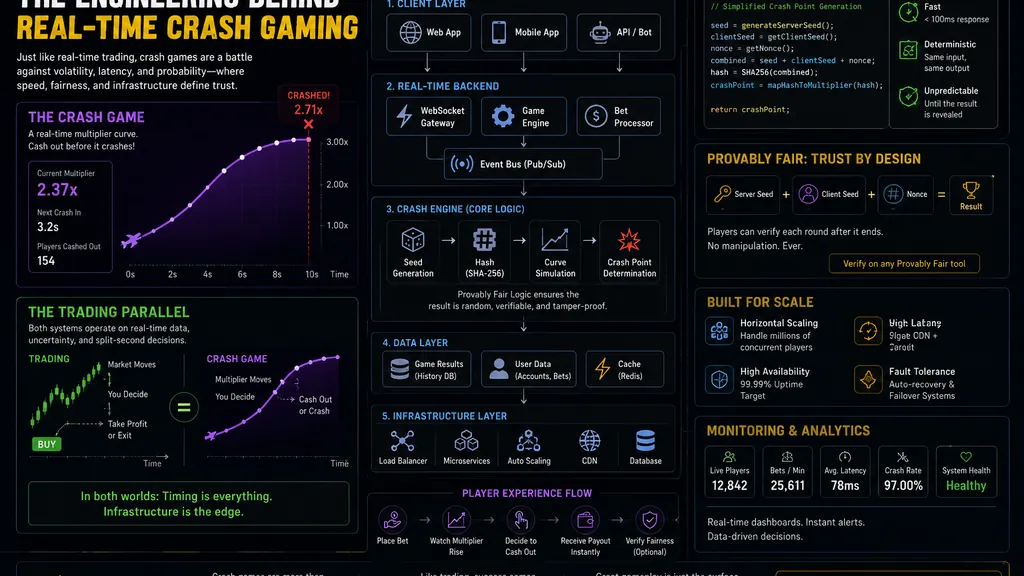
Aviator Game Architecture Mirrors High-Frequency Trading Systems
Crash gaming platforms like Aviator employ real-time event processing and low-latency infrastructure similar to high-frequency trading systems, according to technical analysis. The parallel architecture reflects shared engineering challenges in speed-critical applications across gaming and finance.
Written by CoinArticle’s AI Newsroom · from 1 cited source. How we work
Shared Infrastructure Patterns
Crash games like Aviator use event-driven architecture and microsecond-precision timing mechanisms analogous to those deployed on modern trading desks. Both systems must process concurrent user inputs, execute state transitions, and broadcast results across distributed networks with minimal latency. The underlying software stack prioritizes low-latency messaging protocols and deterministic execution to ensure fairness and prevent race conditions.
Why Speed Matters in Both Contexts
In high-frequency trading, latency differences measured in milliseconds determine profitability. Crash games face similar constraints: players must see consistent, real-time updates during rapid price movements, and any server-side delays create perceptual unfairness or technical arbitrage opportunities. Both domains therefore employ similar optimization techniques—message batching, event loop tuning, and hardware-accelerated networking—to maintain sub-100-millisecond round-trip times.
Engineering Tradeoffs
The convergence reflects broader patterns in real-time systems engineering. Both trading platforms and crash games must balance throughput, latency, and consistency while managing state across multiple clients. However, the regulatory and trust requirements differ sharply: trading infrastructure operates under SEC oversight with audit trails and settlement guarantees, while crash game platforms operate with varying jurisdictional clarity.
Why It Matters
For Traders
The technical similarity does not confer trading-like predictability; crash game outcomes remain provably random and unrelated to market microstructure.
For Investors
Gaming platforms adopting financial-grade infrastructure raises questions about regulatory classification and whether crash games face future compliance pressures.
For Builders
Low-latency event-driven architectures proven in trading systems are transferable templates for any real-time application, but regulatory treatment differs by use case.
This article is for information only and is not financial advice. Read the full disclaimer.