Bitcoin Funding Rates Turn Negative as Traders Debate Cycle Thesis
Bitcoin's derivatives markets are showing negative funding rates, a pattern typically associated with bearish positioning that some analysts interpret as contrarian bullish signal. Meanwhile, prominent market participants remain divided on whether the traditional four-year halving cycle still drives price action, with year-end forecasts ranging from no new highs to $250,000.
Written by CoinArticle’s AI Newsroom · from 1 cited source. How we work
Funding Rate Divergence
Negative funding rates on major Bitcoin futures exchanges signal that traders holding short positions are paying those holding long positions to maintain their bets. Historically, such conditions emerge when leverage is concentrated on the bearish side. However, market observers increasingly view persistently negative funding as a contrarian indicator—a sign that short positioning has become crowded and vulnerable to liquidation cascades if price moves upward.
The Four-Year Cycle Debate
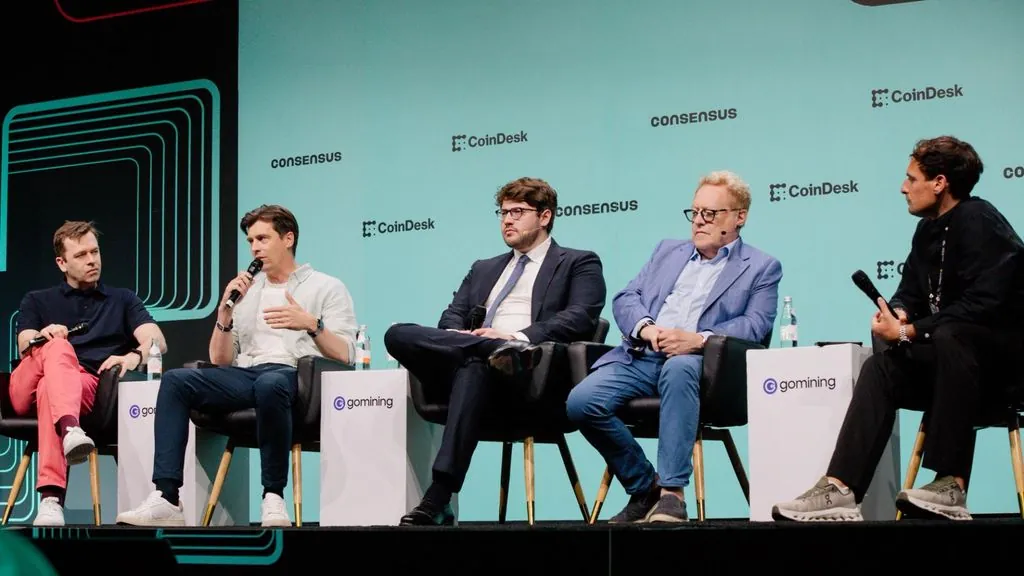
Panelists discussing Bitcoin's near-term direction are split on the predictive power of the halving cycle, which has historically corresponded with bull markets in years following the network's supply reduction. Price targets for year-end vary dramatically across major market participants, from forecasts of no new all-time high to bullish calls as high as $150,000 to $250,000. The lack of consensus reflects deeper uncertainty about whether macro conditions, regulatory shifts, or institutional adoption patterns have outpaced the cycle's traditional influence.
What Traders Are Positioning For
The combination of negative funding and wide forecast dispersion suggests traders are hedging aggressively rather than holding strong directional conviction. Large liquidation levels on both sides of the market remain in place, indicating that a sharp move in either direction could force automated selling or short-covering at scale. This structural setup is what many derivatives analysts point to when interpreting negative funding as bullish—not because bearishness is itself positive, but because it represents untapped margin for an upside move.
Why It Matters
For Traders
Negative funding rates paired with wide liquidation levels mean both long and short positions carry execution risk; watch for volume spikes at key price levels over the next 72 hours.
For Investors
Divergent year-end forecasts from credible analysts suggest the four-year cycle's predictive power may be weakening relative to macro and regulatory factors, reshaping how to model Bitcoin's multi-month returns.
For Builders
Funding rate volatility drives liquidity concentration on perpetuals; protocols designing margin or lending products should monitor which derivatives exchanges are seeing the most leverage unwind.
This article is for information only and is not financial advice. Read the full disclaimer.