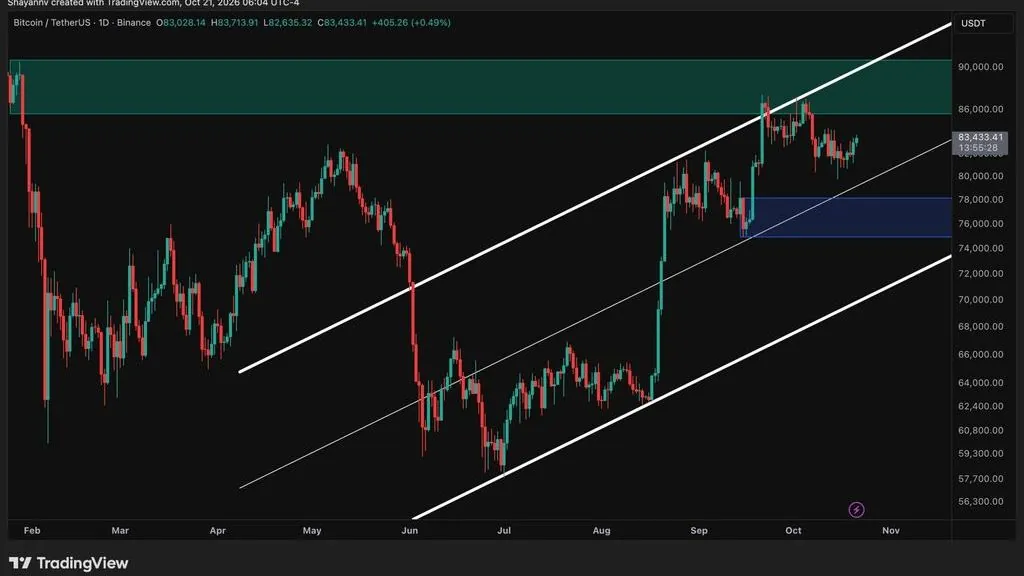
Bitcoin's Volatility Hits Record Lows: A New Era for Crypto Markets
Bitcoin enters 2025 with unprecedented market stability, driven by institutional investment strategies. This evolution could reshape the cryptocurrency landscape, attracting risk-conscious investors.
Written by CoinArticle’s AI Newsroom · from 1 cited source. How we work
Market Volatility Reaches New Lows
Bitcoin's traditionally turbulent market has entered an unprecedented period of stability in 2025, with implied volatility metrics showing a consistent downward trend. This shift marks a significant departure from the cryptocurrency's historical price behavior, which has long been characterized by dramatic swings that attracted speculators while deterring conservative investors.
Institutional Influence on Market Dynamics
The declining volatility can be primarily attributed to the growing presence of institutional investors in the Bitcoin market. These sophisticated market participants have adopted a different approach to cryptocurrency trading compared to retail investors, fundamentally altering the market's behavioral patterns.
In contrast to earlier market cycles dominated by speculative retail trading, institutional players are implementing more measured strategies focused on consistent returns rather than rapid price appreciation. This shift towards a more systematic investment approach has contributed to dampening the traditional boom-and-bust cycle that defined Bitcoin's past.
Derivatives-Driven Income Strategies
A key factor in Bitcoin's stabilization has been the strategic use of derivatives by institutional investors. These market participants are actively deploying options and futures contracts, employing tactics such as covered call strategies and other income-generating approaches.
By systematically selling options against their Bitcoin positions, institutions create natural price ceilings and floors that effectively mitigate extreme price movements. This derivatives activity not only enhances liquidity within the markets but also absorbs volatility that might otherwise manifest in spot trading.
Implications for the Broader Market
The reduction in Bitcoin's implied volatility carries several significant implications for the cryptocurrency ecosystem. Lower volatility may enhance Bitcoin's appeal as a treasury asset for corporations and increase its viability for payment applications, where price stability is essential.
However, this reduced volatility could also translate to smaller returns for traders who have historically profited from Bitcoin's dramatic price swings. This evolution suggests that the market is maturing beyond its speculative origins toward a more established and recognized asset class.
Conclusion
The calming of Bitcoin's volatility in 2025 represents a watershed moment in the development of cryptocurrency markets. As institutional investors continue to deploy sophisticated derivatives strategies for yield generation, the character of the market is fundamentally transforming. While this shift may disappoint volatility-seeking traders, it potentially positions Bitcoin for broader adoption among risk-conscious institutional allocators and mainstream financial applications.
Why It Matters
For Traders
With reduced volatility, traders may need to adapt their strategies as the traditional price swings that created profit opportunities are less frequent.
For Investors
Long-term investors may find Bitcoin increasingly attractive as a stable asset for treasury management and a hedge against inflation in uncertain economic climates.
For Builders
Developers can leverage this trend to create innovative financial instruments and applications that cater to a more stable and mature Bitcoin market, fostering growth in decentralized finance (DeFi) and payment solutions.
This article is for information only and is not financial advice. Read the full disclaimer.