CLARITY Act Advances to 2026 Markup Amid DeFi Regulation Concerns
The CLARITY Act has secured a January 2026 markup, marking progress toward crypto regulation. However, its omission of DeFi rules raises concerns about retail investor protections in this rapidly growing sector.
Written by CoinArticle’s AI Newsroom · from 2 cited sources. How we work
CLARITY Act Advances to 2026 Markup Amid DeFi Regulation Concerns
The long-awaited CLARITY Act has reached a critical legislative milestone, with Senate leaders confirming a January 2026 markup. Yet, the bill’s glaring omission of decentralized finance (DeFi) regulations has sparked concerns about potential risks to retail investors if lawmakers fail to address this gap.
What We Know
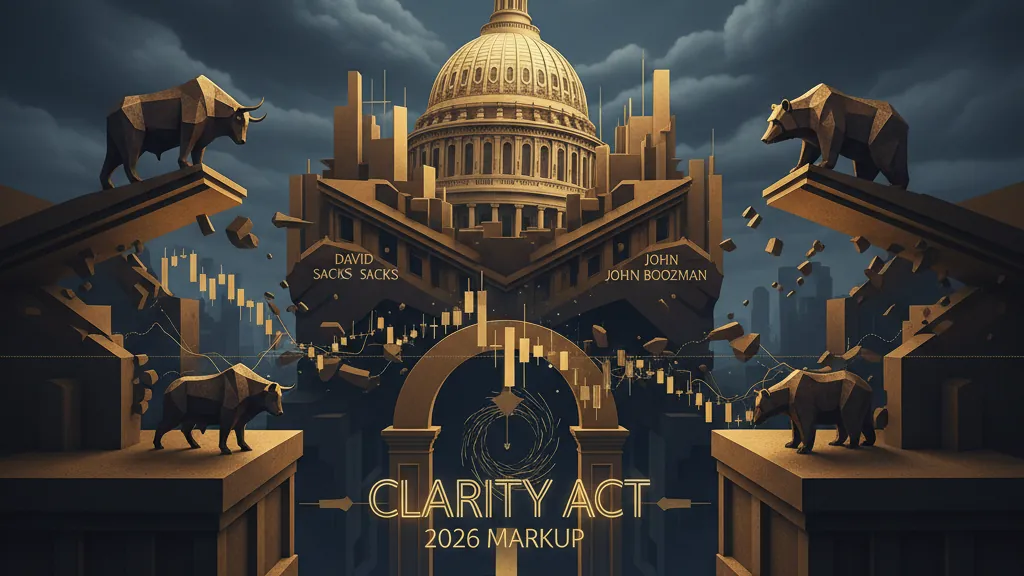
On December 18, David Sacks announced that Senate Banking Chair Tim Scott and Senate Agriculture Chair John Boozman have confirmed plans for a January 2026 markup of the CLARITY Act. Both CryptoSlate and BITRSS report this development as a significant step toward establishing a regulatory framework for digital assets.
"We look forward to finishing the job in January!" Sacks stated, expressing optimism about the legislation’s progress.
However, the bill explicitly leaves DeFi regulations unaddressed—a notable omission in what is intended to be comprehensive crypto legislation. This regulatory gap has raised alarms about the adequacy of protections for retail investors engaging in the rapidly expanding decentralized finance sector.
Key Details
The January 2026 markup signals the beginning of what could be a lengthy legislative process. As noted by both sources, this milestone should be seen as an opening move in a multi-year pipeline rather than a near-term conclusion.
The omission of DeFi regulations is particularly concerning given the sector’s explosive growth, with hundreds of billions of dollars in locked value and increasing retail participation. While centralized exchanges and financial services would receive clearer regulatory guidance under the CLARITY Act, decentralized protocols—operating without central intermediaries—remain in a regulatory void.
Both CryptoSlate and BITRSS warn that if negotiations surrounding the CLARITY Act falter, this gap could lead to a collapse in retail protections, leaving everyday investors vulnerable in an increasingly complex crypto landscape.
The involvement of both the Senate Banking Committee and Senate Agriculture Committee highlights ongoing jurisdictional debates over which congressional bodies should oversee crypto regulation. Securities oversight falls under banking, while commodities oversight falls under agriculture.
What’s Still Uncertain
The timeline for the legislative process beyond the January 2026 markup remains unclear. While sources describe a “multi-year pipeline,” the exact duration and steps required for the CLARITY Act to become law have not been detailed.
It’s also uncertain whether DeFi regulations will be addressed through amendments during the markup process, through separate legislation, or via regulatory actions by agencies independent of Congress.
Why This Matters
The CLARITY Act represents one of Congress’s most significant efforts to establish clear rules for the cryptocurrency industry, which has operated under regulatory ambiguity for years. Clear regulations could provide legitimacy to the sector, attract institutional investment, and protect consumers from fraud and manipulation.
However, the absence of DeFi provisions creates a substantial blind spot. DeFi has emerged as one of crypto’s most innovative yet riskiest sectors, with retail investors increasingly participating in complex protocols involving lending, borrowing, and trading without traditional intermediaries.
If the legislation advances without addressing DeFi—or if negotiations break down entirely—millions of retail investors could remain exposed to risks such as smart contract vulnerabilities, rug pulls, and complex financial mechanisms that many participants struggle to understand.
The January 2026 markup will be closely watched as a key indicator of whether lawmakers can build consensus on crypto regulation—and whether DeFi will finally receive the regulatory attention it urgently needs.
Key entities: David Sacks, Tim Scott, John Boozman, CLARITY Act, Senate Banking Chair, Senate Agriculture Chair
Sentiment: Bearish
This article is for information only and is not financial advice. Read the full disclaimer.