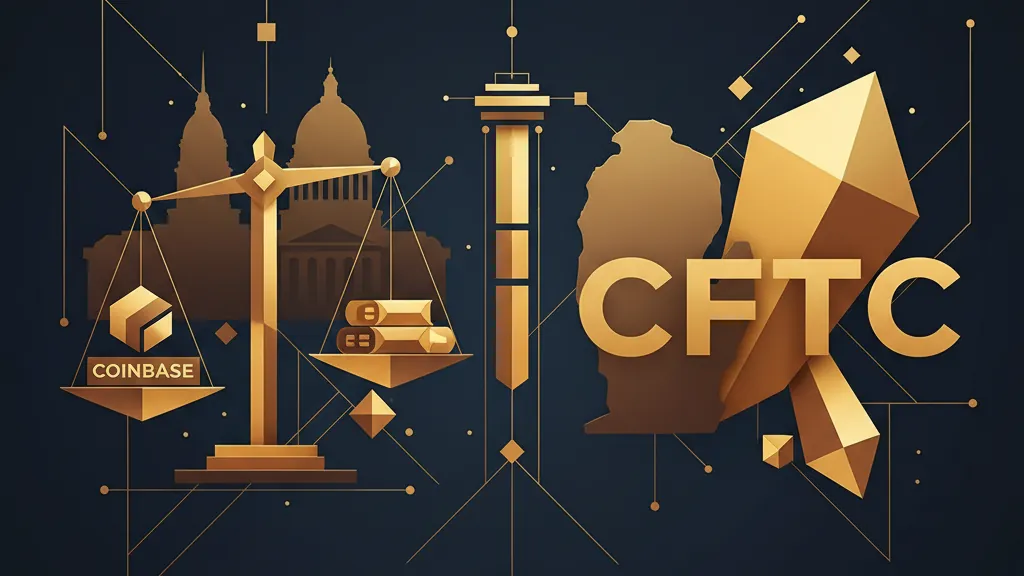
Coinbase Takes on State Regulators in Prediction Market Legal Battle
Coinbase has filed lawsuits in Michigan, Illinois, and Connecticut, asserting that federal regulators should oversee prediction markets on cryptocurrency platforms, challenging the state’s interpretation of these markets as gambling.
Written by CoinArticle’s AI Newsroom · from 1 cited source. How we work
Coinbase Challenges State Regulators Over Prediction Market Oversight
Coinbase has initiated a multi-state legal offensive by filing lawsuits against regulators in Michigan, Illinois, and Connecticut, sparking a crucial debate over the regulatory authority governing prediction markets on cryptocurrency platforms.
Federal Versus State Regulatory Authority
In its legal filings, Coinbase asserts that prediction markets should fall under the jurisdiction of the Commodity Futures Trading Commission (CFTC), a federal entity tasked with overseeing derivatives markets. This stance directly contests state regulators' attempts to categorize and regulate these markets as gambling activities, which have traditionally been managed at the state level.
The lawsuits signify Coinbase's effort to clarify regulatory boundaries for prediction markets—platforms where users can wager on the outcomes of numerous future events, such as elections and economic indicators. The exchange argues these markets should be viewed as derivative instruments rather than gambling products, thereby firmly situating them within federal regulatory oversight.
Broader Implications for Market Regulation
The implications of this legal confrontation extend far beyond Coinbase, holding considerable significance for the entire cryptocurrency industry and prediction markets alike. The resolution of these disputes may dictate whether such platforms are subjected to a fragmented array of state regulations or a cohesive federal oversight framework.
Should the courts side with Coinbase, prediction markets could be regulated by the CFTC, which would likely yield more uniform standards across the nation. Conversely, a ruling in favor of state regulators might impose varying requirements and restrictions, complicating operations for national exchanges.
This case also emphasizes the ongoing tensions between federal and state authorities in the fast-evolving landscape of digital assets, where traditional regulatory models frequently struggle to properly address new financial products and technologies.
Industry-Wide Impact
Coinbase's legal challenge arrives at a time when prediction markets are experiencing heightened interest and user engagement. The outcomes of these lawsuits are poised to set vital precedents impacting not only Coinbase but also other platforms that offer similar services.
State regulators have historically maintained control over gambling activities, while the CFTC has established authority over futures and derivatives trading. Prediction markets exist in a gray area straddling these two categories, making this legal battle an imperative examination of regulatory boundaries in the digital age.
The outcomes in Michigan, Illinois, and Connecticut may influence how other states approach prediction market regulation, potentially prompting federal legislative action to clarify jurisdictional authority over these emerging financial instruments.
Why It Matters
For Traders
Traders should keep a close watch on the evolution of regulatory frameworks affecting prediction markets, as a federal standard may streamline trading strategies and broaden market access.
For Investors
Long-term investors in cryptocurrency platforms may find greater confidence in a unified regulatory environment, which could enhance market stability and reduce operational risks associated with fragmented state regulations.
For Builders
Developers and builders in the crypto space should consider the implications of this legal battle on product development and compliance strategies, as the outcome could either foster innovation or impose restrictive regulations on new financial technologies.
This article is for information only and is not financial advice. Read the full disclaimer.