Corporate Bitcoin Holdings Fall $62 Billion in Value Since Peak
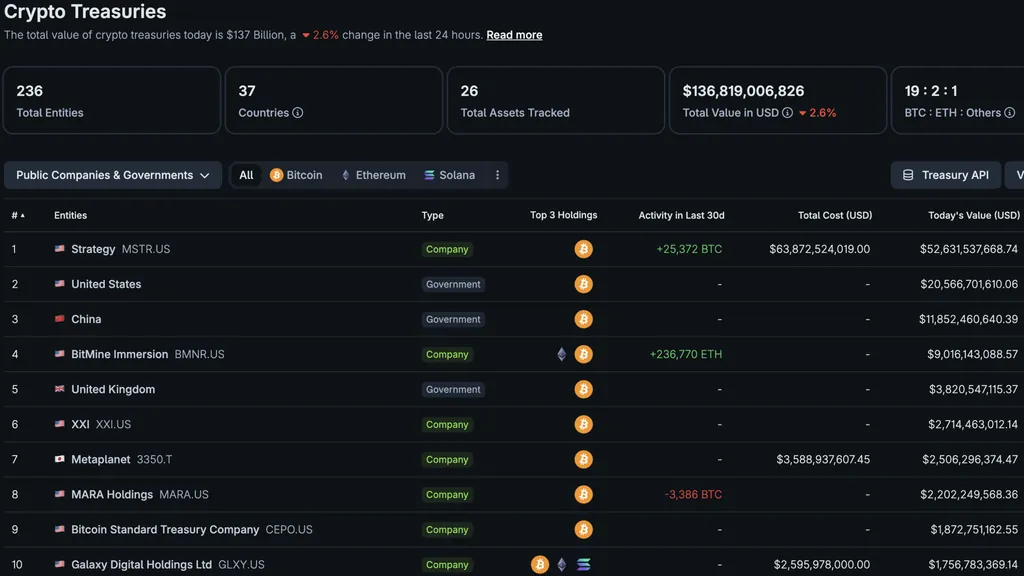
Major corporations' collective Bitcoin holdings have declined $62 billion in value from their peak, raising questions about whether the corporate treasury movement will regain momentum. The decline reflects both price weakness and reduced accumulation by public companies.
Written by CoinArticle’s AI Newsroom · from 1 cited source. How we work
Corporate Positions Under Pressure
Publicly listed companies that hold Bitcoin on their balance sheets have seen their aggregate positions lose approximately $62 billion in value from the prior peak, according to analysis of corporate filings. The figure encompasses holdings by firms including MicroStrategy, Tesla, and others that have disclosed Bitcoin acquisitions as part of strategic treasury diversification.
The decline tracks broader Bitcoin price weakness over the past 18 months. Bitcoin traded as high as $69,000 in November 2021 before falling 65% to lows near $16,600 in November 2022. While the asset has recovered substantially since then, corporate holdings accumulated at higher prices have not fully retraced to their mark-to-market peaks.
Slowing Accumulation Trend
The enthusiasm for corporate Bitcoin adoption that peaked in 2020-2021 has not resumed at prior intensity. Few Fortune 500 companies have announced new Bitcoin treasury programs in recent quarters, and several early adopters including Tesla have reduced or suspended purchases. MicroStrategy remains the most aggressive active accumulator, but quarterly additions have not offset valuation pressure on the broader portfolio.
Analysts point to several headwinds: higher interest rates making Treasury yields competitive with speculative assets, uncertainty around cryptocurrency regulation, and macroeconomic volatility that has shifted corporate finance priorities toward cash preservation rather than alternative asset experimentation.
Why It Matters
For Traders
Reduced corporate bid for Bitcoin removes a category of large structural buyer that supported prices during the 2020-2021 rally, though current holdings remain material.
For Investors
Corporate adoption's slowdown suggests mainstream institutional confidence in Bitcoin as a treasury reserve asset remains contingent on price direction and regulatory clarity.
For Builders
Stalled corporate adoption may shift focus from appealing to CFOs toward building use cases for Bitcoin within applications rather than as a passive treasury asset.
This article is for information only and is not financial advice. Read the full disclaimer.