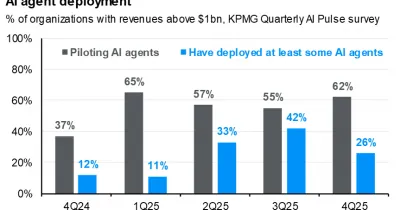
JPMorgan: AI Agent Deployment Surges Among Large Firms as Broader Adoption Stalls
JPMorgan analysis finds large enterprises are rapidly deploying AI agents while adoption among smaller firms remains flat, widening the gap between tech leaders and others. The divergence signals concentration of advanced AI infrastructure among bigger players.
Written by CoinArticle’s AI Newsroom · from 1 cited source. How we work
Enterprise Deployment Accelerates
JPMorgan's analysis shows AI agent deployment among large financial firms is accelerating, with major institutions integrating autonomous agents into trading, risk management, and client-facing operations. The bank did not specify deployment timelines or quantify the absolute number of agents in production, but described the trend as a meaningful shift in how large firms are operationalizing large language models beyond experimental phases.
Adoption Gap Widens
The same report found that adoption rates among smaller enterprises and mid-market firms have plateaued, creating a two-tier landscape in enterprise AI implementation. JPMorgan attributes the divide to differences in capital availability, technical talent density, and infrastructure readiness. Smaller firms report barriers including cost of implementation, lack of specialized engineering staff, and difficulty integrating agents into legacy systems.
Structural Implications
The divergence reflects a broader pattern in AI infrastructure adoption: early movers with deep pockets and existing data pipelines capture outsized efficiency gains, while constrained firms struggle to justify or execute deployment. For the blockchain and DeFi sectors, this dynamic may inform how enterprise-grade tokenization platforms and on-chain AI oracle networks position themselves—either as solutions accessible to mid-market firms or as premium infrastructure for large institutions.
Why It Matters
For Traders
No immediate market pricing signal; this is structural trend data relevant only if it influences enterprise adoption of crypto infrastructure or tokenized assets.
For Investors
Widening adoption gaps in enterprise AI may mirror patterns in crypto adoption; assets positioned as accessible to mid-market firms could gain relative upside.
For Builders
The deployment bottleneck for smaller enterprises suggests demand for modular, lower-cost AI infrastructure; blockchain-based oracle networks and tokenized AI services may find an addressable market.
This article is for information only and is not financial advice. Read the full disclaimer.