US Crypto Gambling Legality Remains Fragmented Across States in 2026
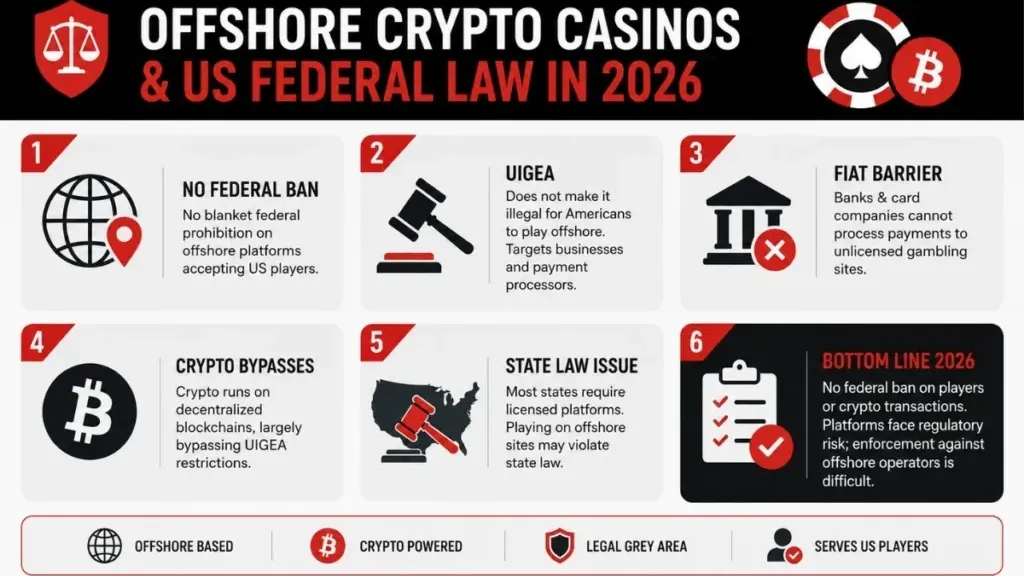
A state-by-state breakdown shows US crypto gambling regulations remain inconsistent as of 2026, with no federal framework governing Bitcoin-powered casinos or offshore platforms. Individual states continue to set their own rules for online gaming and sports betting involving digital assets.
Written by CoinArticle’s AI Newsroom · from 1 cited source. How we work
State-by-State Regulatory Patchwork
As of 2026, the United States has no uniform federal standard for cryptocurrency gambling, leaving each state to establish its own legal boundaries. Some states have explicitly permitted online casinos and Bitcoin-powered betting platforms, while others maintain blanket prohibitions or operate in gray zones where digital-asset gaming is neither clearly legal nor explicitly banned.
Online Casinos and Sports Betting Vary
Traditional online sports betting and casino gaming have expanded significantly in certain states since 2020, though the addition of cryptocurrency as a payment method or native gaming asset has created additional compliance uncertainty. Offshore platforms accepting Bitcoin remain widely accessible to US users despite legal ambiguity, as enforcement remains inconsistent across federal and state authorities.
Implications for Crypto Infrastructure
The fragmented landscape has left crypto payment processors, exchange platforms, and gaming operators unable to offer uniform products across all 50 states. Protocol builders developing decentralized gambling platforms face similar jurisdictional hurdles, as the absence of clear federal guidance means compliance strategies must be tailored state-by-state rather than across a single national framework.
Why It Matters
For Traders
Fragmented state rules create operational risk for platforms accepting crypto for gambling; regulatory action in any major state could shift market access quickly.
For Investors
Lack of federal crypto gambling framework signals regulatory uncertainty will persist; states moving to permit or ban digital-asset gaming may signal broader attitudes toward crypto adoption.
For Builders
Protocol teams targeting gambling or betting use cases must plan for per-state compliance rather than single national integration, raising infrastructure costs significantly.
This article is for information only and is not financial advice. Read the full disclaimer.