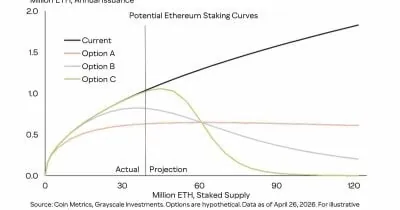
Ethereum Explores Changes to Staking Reward Model
Ethereum developers are considering modifications to the staking reward structure to better control inflation. The proposed changes aim to improve long-term token economics amid growing Layer 2 adoption.
Written by CoinArticle’s AI Newsroom · from 1 cited source. How we work
Staking Model Under Review
Ethereum stakeholders are evaluating potential adjustments to the protocol's staking reward mechanism. The discussions focus on inflation control and how rewards structure incentivizes validator participation without excessive issuance that could dilute holder value.
Economic Rationale
Proponents of the change argue that a revised reward model could improve Ethereum's macroeconomic profile by reducing annual token issuance while maintaining network security. The timing aligns with increased transaction volume shifting to Layer 2 scaling solutions, which affects base-layer fee dynamics and validator economics.
Broader Context
Ethereum's current staking system, implemented during the 2022 transition to proof-of-stake, generates rewards from validator duties and transaction fees. Any modifications to the reward structure would require consensus among Ethereum node operators and community governance, a process that typically extends over multiple development cycles.
Why It Matters
For Traders
Staking reward changes could reshape APY calculations for ETH stakers and affect validator economics in the near term.
For Investors
Lower issuance would reduce dilution on ETH supply, potentially improving long-term token scarcity relative to demand.
For Builders
Changes to validator incentives may alter economic assumptions in protocols that depend on Ethereum's security layer or liquid staking derivatives.
This article is for information only and is not financial advice. Read the full disclaimer.