Martingale and Paroli Betting Systems Cannot Beat House Edge, Analysis Shows
A comparative analysis of two popular roulette betting strategies—Martingale and Paroli—concludes neither system can overcome the inherent house advantage in casino games. Both approaches rely on betting progression rather than probability adjustment, leaving players exposed to the same mathematical disadvantage.
Written by CoinArticle’s AI Newsroom · from 1 cited source. How we work
How Martingale and Paroli Differ
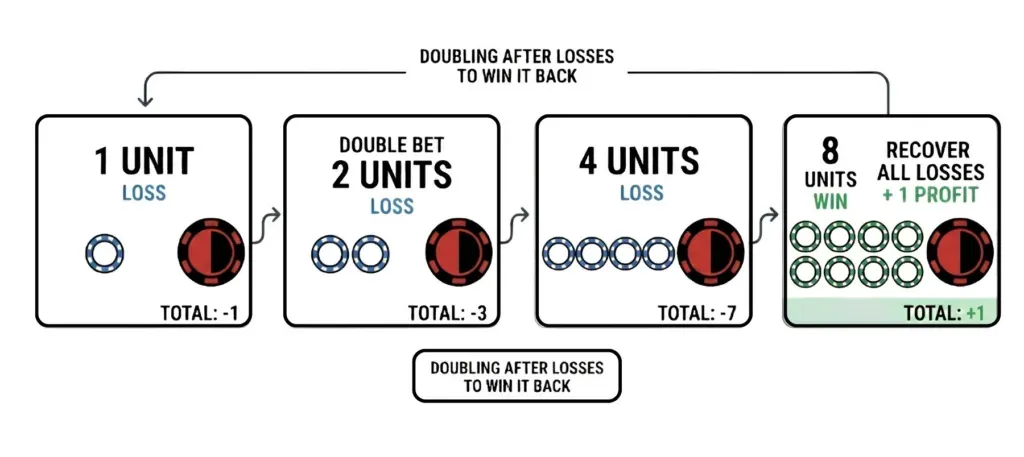
Martingale and Paroli represent opposite betting progressions on even-money wagers. Martingale requires doubling the bet after each loss, with the goal of recovering all prior losses plus gaining one unit of profit when a win eventually arrives. Paroli follows the inverse logic: doubling the bet after each win to ride a winning streak, then resetting after a predetermined number of consecutive wins.
Traders and recreational gamblers have used both systems across roulette, blackjack, and sports betting for centuries, often with the belief that disciplined bet sizing can offset randomness.
Why Neither System Beats the House
Both Martingale and Paroli fail to change the underlying probability or payout structure of the game. In American roulette, the house edge remains 5.26% on every spin regardless of bet size or sequence. European roulette carries a 2.70% edge. A betting progression cannot alter these fixed odds.
Martingale carries the additional practical risk of hitting table limits or depleting a player's bankroll before a win arrives. During a losing streak, doubling bets exponentially increases total capital at risk. Paroli avoids catastrophic loss but also cannot generate positive expected value over time—it simply redistributes when losses occur, not whether they occur.
Mathematical analysis confirms that no betting system can overcome a negative expected value game through bet sizing alone. The house edge persists independent of strategy, making long-term profitability impossible for either approach.
Why It Matters
For Traders
No relevance to crypto markets or digital asset trading; applies only to casino games and does not inform position management in volatile crypto markets.
For Investors
The underlying principle—that betting progression cannot overcome negative expected value—parallels some cryptocurrency risk discussions, though markets have asymmetric payoff structures.
For Builders
No technical or product relevance to protocol development, smart contracts, or decentralized infrastructure.
This article is for information only and is not financial advice. Read the full disclaimer.