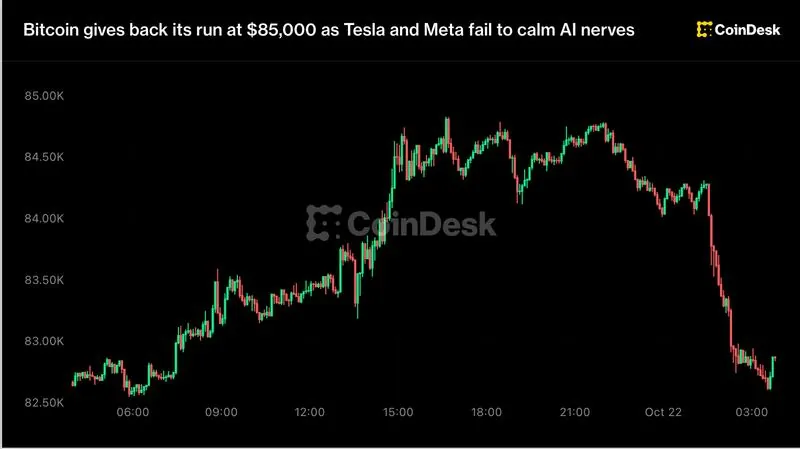
Bitcoin Retreats to $82,500 as Tech Volatility Pressures Rally
Bitcoin fell back below $84,000 on Wednesday after briefly breaking through that level, sliding toward $82,500 as weakness in tech futures offset recent gains. Analysts are monitoring the $82,500 level as a key support zone ahead of the Federal Reserve's late October meeting.
Written by CoinArticle’s AI Newsroom · from 2 cited sources. How we work
Price Action and Failed Rally
Bitcoin rose to $85,000 late Wednesday before retreating to around $82,500, according to CoinDesk. The move erased a near-term rally that had taken the asset close to $83,000 earlier in the session. Analyst commentary attributed the pullback partly to weakness in technology stocks, with declines in mega-cap holdings including Tesla and Meta offsetting cryptocurrency momentum.
Support Levels Under Scrutiny
The $82,500 level has emerged as the immediate technical floor traders are monitoring, according to reporting from CoinDesk. Glassnode's proximity framework, cited by CryptoSlate, offers a methodology for assessing whether nearby on-chain inventory and actual buy-side demand can confirm support at this level. The framework examines holder distribution and historical accumulation patterns to gauge whether a price floor is sustainable or merely a technical level without fundamental backing.
Timing and Fed Meeting Risk
The price consolidation is occurring ahead of the Federal Reserve's late October 27–28 meeting, which carries implications for risk asset demand more broadly. Broader equity volatility appears to be flowing through to bitcoin positioning as traders reassess their exposure ahead of potential Fed guidance.
Why It Matters
For Traders
Bitcoin's $82,500 support is now actively tested; a break below invites further liquidations, while a hold could signal accumulation before the Fed meeting.
For Investors
Tech stock contagion affecting risk appetite poses a near-term headwind for BTC; Fed communications later this month will likely dictate broader direction.
For Builders
Volatility spikes tied to macro events create margin-call cascades on leverage-heavy chains; protocols relying on stable borrowing costs may experience temporary stress.
This article is for information only and is not financial advice. Read the full disclaimer.