Cardano Breaks Below $0.22 Support as Whale Activity Wanes
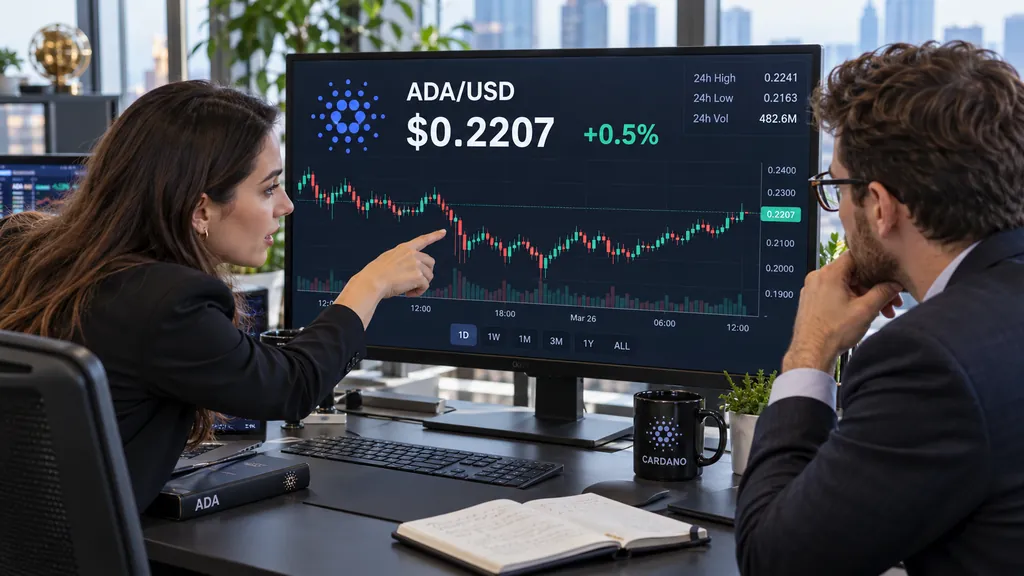
Cardano fell below the $0.22 support level Thursday, failing to sustain gains above its 50-day moving average. On-chain metrics show whales retreating and derivatives traders positioning for further downside, though a confirmed breakdown requires additional losses.
Written by CoinArticle’s AI Newsroom · from 2 cited sources. How we work
Price Action Below Key Level
Cardano traded below $0.22 on Thursday after failing to hold above its 50-day exponential moving average, according to CoinJournal reporting. CryptoPotato characterized the technical picture as flashing a sell signal, though cautioned that the signal alone does not confirm a full breakdown. If $0.21 fails to hold, further downside may follow, analysts noted.
Derivatives and Whale Positioning Shift Bearish
On-chain data showed mounting pressure from derivatives markets. ADA's long-to-short ratio fell to 0.79, approaching its lowest reading in more than a month per CoinJournal. Negative funding rates signal increased demand for bearish derivatives exposure among traders. Separately, whale activity has quieted, suggesting large holders are neither buying into weakness nor aggressively defending current levels.
What Matters for Near-Term Moves
The convergence of a broken moving average, deteriorating long-to-short ratio, and reduced whale participation suggests the near-term technical backdrop has weakened. However, whether this amounts to a sustained downtrend or a tactical pullback depends on whether support at $0.21 holds and whether whale accumulation resumes at lower prices.
Why It Matters
For Traders
ADA below $0.22 with weak whale support suggests tactical traders should watch $0.21 as next critical support; break risks cascading liquidations.
For Investors
Sustained weakness below moving averages and negative funding rates historically precede multi-week downtrends; position sizing may warrant review.
For Builders
No direct protocol impact; Cardano's technical weakness does not affect dApp or validator security, though lower price may reduce ecosystem incentive yields.
This article is for information only and is not financial advice. Read the full disclaimer.