Clarity Act's Passage Odds Fall as Senate Negotiations Stall
Prediction markets have sharply reduced the odds of the Clarity Act passing after Democrats rejected Republicans' counter-proposal in stalled Senate negotiations. The downturn in market odds has coincided with declines across major cryptocurrency assets.
Written by CoinArticle’s AI Newsroom · from 2 cited sources. How we work
Negotiations Break Down Hours Before Vote
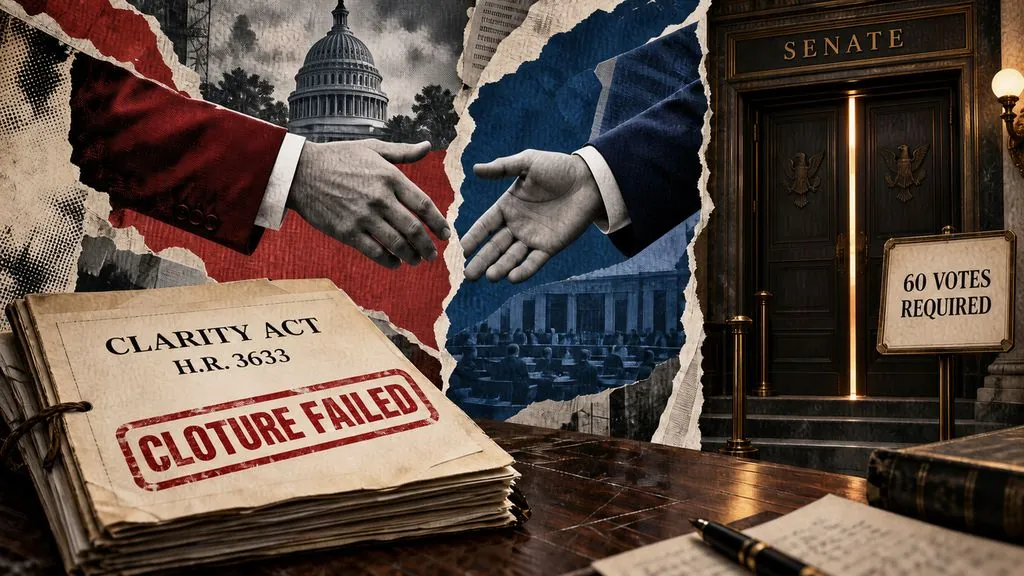
Prediction market odds for the Clarity Act's passage have reversed their recent gains and fallen to new lows as Senate negotiations between Republicans and Democrats reached an impasse hours before a key vote. According to CoinDesk reporting, Republicans presented a counter-proposal that Democrats rejected, leaving the two sides unable to reach agreement on the bill's framework.
Market Reaction Mirrors Legislative Setback
The collapse in legislative prospects has tracked closely with price movement across major cryptocurrencies. Decrypt reported that crypto assets reversed their recent gains in tandem with the deterioration in the Clarity Act's odds, suggesting traders are pricing in a lower probability of near-term passage. The synchronized moves across prediction markets and spot prices indicate the crypto market views the bill's prospects as a material factor in the near-term risk landscape.
Path Forward Uncertain
With the Senate vote imminent and negotiations stalled, the immediate outlook for the Clarity Act remains unclear. The reversal of previously bullish sentiment in prediction markets reflects investor skepticism about the likelihood of a breakthrough before the scheduled vote.
Why It Matters
For Traders
Crypto spot weakness tied to Clarity Act odds suggests positioning risk if negotiations unexpectedly resume; watch prediction market moves for entry signals.
For Investors
Failure to pass crypto market structure reform signals continued regulatory uncertainty and delays in establishing a transparent U.S. digital asset framework.
For Builders
Stalled federal crypto legislation means protocol teams and exchanges should plan for prolonged state-by-state and agency-by-agency compliance patchwork rather than unified rules.
This article is for information only and is not financial advice. Read the full disclaimer.