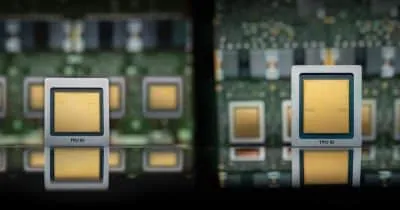
Google, MediaTek Partner on Enhanced TPU v9 Chip for AI Workloads
Google and MediaTek announced a partnership to develop an enhanced version of Google's TPU v9 tensor processing unit for AI applications. The collaboration could alter competitive dynamics in AI semiconductor supply and affect infrastructure costs for on-chain and off-chain compute services.
Written by CoinArticle’s AI Newsroom · from 1 cited source. How we work
Partnership Scope
Google and MediaTek are collaborating on development of an enhanced TPU v9 chip, according to reporting from Crypto Briefing. The partnership pairs Google's tensor processing unit design expertise with MediaTek's semiconductor manufacturing and optimization capabilities. Details on timeline, performance targets, or pricing were not disclosed in available statements.
Market Implications
The partnership could reshape the AI semiconductor landscape, which has been dominated by NVIDIA's GPU offerings. Broader access to optimized tensor processing units could lower costs for organizations running large language models and other AI inference workloads, including blockchain infrastructure providers that rely on external compute for node operation and validation tasks. MediaTek's scale in mobile and edge computing could extend TPU availability beyond Google's data centers.
Crypto Infrastructure Context
Reduced AI chip costs have indirect implications for blockchain infrastructure. Layer 1 and Layer 2 validators, sequencers, and data providers increasingly use external compute for proof generation and state verification. Lower tensor processing costs would compress operational expenses for these services, potentially improving margins or enabling more distributed validator participation across networks that depend on specialized compute.
Why It Matters
For Traders
Lower AI compute costs could reduce infrastructure overhead for blockchain services; monitor for announcements of specific on-chain applications leveraging cheaper TPU access.
For Investors
Reduced tensor processing unit costs may compress margins for AI compute providers while expanding TAM for edge and on-chain inference applications over 12-24 months.
For Builders
Broader TPU availability could lower barriers to deploying proof-generation and verification systems on decentralized networks, enabling new on-chain AI product categories.
This article is for information only and is not financial advice. Read the full disclaimer.