Hyperliquid Trader Loses Millions as 50,000 ETH Short Liquidates in Seconds
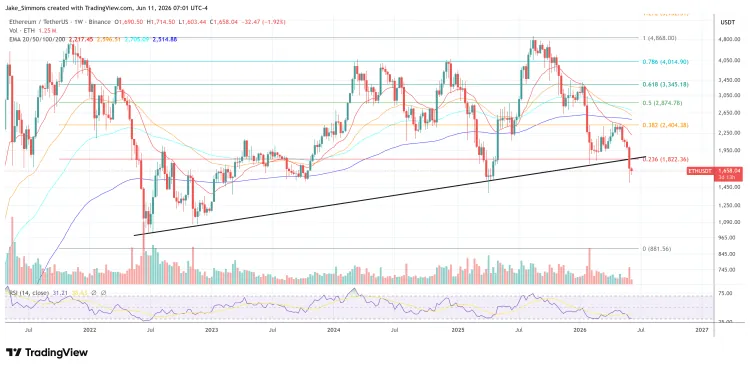
A prominent Hyperliquid trader holding a 50,000 ETH short position was forcibly liquidated in seconds as ether rallied, with reported losses ranging from $24 million to $26 million. Multiple liquidation orders during the unwind amplified price movement on the decentralized perpetuals exchange.
Written by CoinArticle’s AI Newsroom · from 2 cited sources. How we work
The Liquidation Event
The wallet pension-usdt.eth, operated by a trader with a notable track record shorting crypto assets, was liquidated out of a 50,000 ETH short position on Hyperliquid in approximately 12 seconds, according to CoinDesk. The forced liquidation coincided with a sharp rally in ether price. Reports on the loss magnitude differ: CoinDesk reported a $24 million loss, while NewsBTC cited $26 million in losses from the unwind.
How the Unwind Amplified Price Movement
The liquidation was not instantaneous but unfolded through multiple liquidation orders that contributed to upward pressure on ether during the brief window. The cascading nature of these orders — typical in leveraged markets when collateral thresholds are breached — helped drive the price move that triggered and then accelerated the full unwinding of the position.
The trader behind pension-usdt.eth had previously built a reputation for shorting cryptocurrency, including a widely-reported $49 million gain from earlier short positions. The rapid reversal underscores the tail-risk inherent in concentrated leveraged bets on decentralized derivatives platforms, where large positions can move markets and face liquidation in real time with minimal slippage buffers.
Why It Matters
For Traders
Large liquidations on Hyperliquid can trigger cascading orders; watch for unusual leverage positions and collateral ratios if trading directionally around key support or resistance.
For Investors
Decentralized perpetuals exchanges remain structurally vulnerable to rapid unwinding of large positions, raising questions about market resilience and risk management standards.
For Builders
This event highlights the challenges of liquidation mechanics on orderbook-based DEX derivatives; sequencing and batching of orders during stress periods merit protocol-level review.
This article is for information only and is not financial advice. Read the full disclaimer.