Securitize's Tokenized Assets Hit $4.3B as Revenue Lags Growth
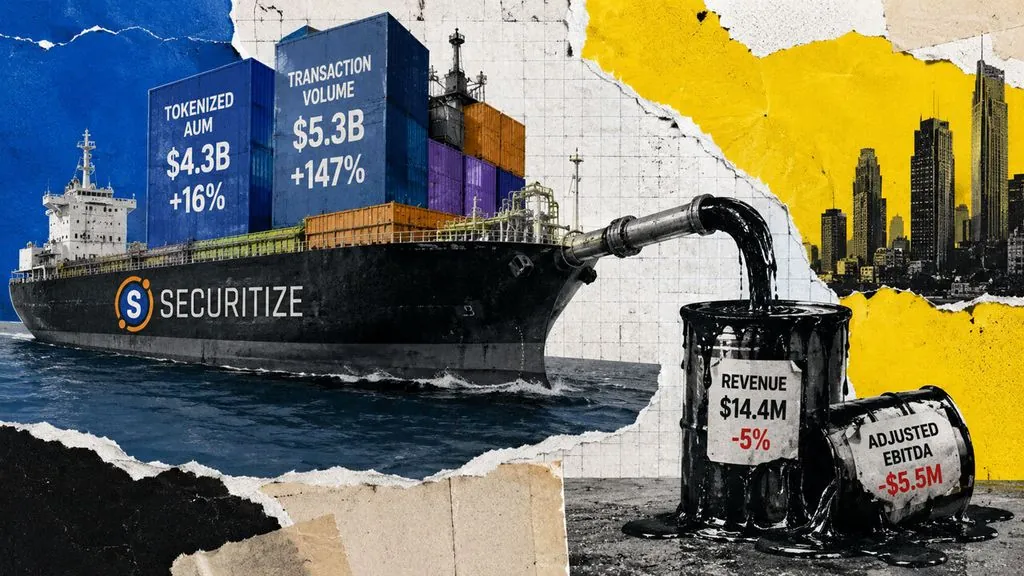
Securitize reported record average tokenized assets under management of $4.3 billion in its first quarter as a public company, up 16% year-over-year, but total revenue fell 5% to $14.4 million. The divergence highlights a persistent tension between platform growth and profitability in the emerging tokenization sector.
Written by CoinArticle’s AI Newsroom · from 2 cited sources. How we work
Assets and Volume Surge While Revenue Shrinks
Securitize closed its first quarter as a public company with average tokenized assets under management reaching $4.3 billion, a 16% year-over-year increase. Transaction volume on the platform jumped 147% to $5.3 billion over the same period. Despite this growth in on-chain activity, total company revenue fell 5% to $14.4 million, while tokenization-specific revenue declined 12% to $7.8 million.
The company's cost structure also moved unfavorably. Operating costs rose 56% according to reporting on the quarter, even as the core revenue lines contracted. The mismatch between transaction-level growth and profitability suggests that higher volumes are not yet translating into proportional fee capture or that Securitize is investing aggressively in infrastructure ahead of monetization.
The Scaling Question
The results surface a structural question for tokenization platforms: whether assets under management can sustainably outpace revenue growth. Securitize's metrics show strong demand for the underlying service—validators and issuers are moving capital on-chain and transacting at higher frequency. Yet the economics of converting that activity into recurring revenue remain unclear. Whether through lower-than-expected transaction fees, higher customer acquisition costs, or a mismatch between the volume of tokenized assets and the volume of fee-generating transactions, the platform has not yet closed the gap between scale and profitability.
Why It Matters
For Traders
Securitize's platform health is less critical to spot prices than traditional market structure, but persistent revenue weakness could signal slower adoption of the tokenization narrative.
For Investors
The gap between asset growth and revenue decline raises questions about whether tokenization is primarily a cost-savings play or a true revenue driver for infrastructure providers.
For Builders
Asset tokenization platforms face pressure to either increase transaction fees or diversify revenue streams; the current model may require scale beyond $4.3B AUM to break even at acceptable margins.
This article is for information only and is not financial advice. Read the full disclaimer.