Yann LeCun's LeJEPA Paper Outlines Conditions for AI World Models
Yann LeCun published research detailing the theoretical conditions under which LeJEPA, a self-supervised learning framework, can learn predictive world models. The findings advance AI's capacity to understand complex systems, though practical deployment faces challenges from environmental variability.
Written by CoinArticle’s AI Newsroom · from 1 cited source. How we work
LeJEPA's Theoretical Foundation
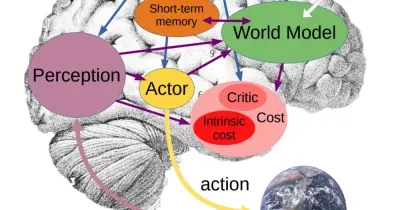
Yann LeCun released a paper outlining the mathematical and structural conditions required for LeJEPA (Latent Equivariance Joint Embedding Predictive Architecture) to successfully learn world models without labeled data. The framework relies on self-supervised learning to extract predictive structure from unlabeled observations, a departure from supervised approaches that require explicit ground-truth labels.
Implications for AI Architecture
LeCun's conditions clarify which architectural choices and data regimes enable LeJEPA to generalize beyond its training distribution. The work suggests a path toward AI systems that can reason about cause and effect in complex environments. However, the paper notes that real-world deployment introduces variability—unmodeled dynamics, sensor noise, and distribution shifts—that can degrade learned representations even when theoretical conditions are met.
Remaining Implementation Challenges
While the theoretical framework is sound, scaling LeJEPA to practical tasks remains difficult. Environments with high stochasticity or hidden variables that affect future states require additional safeguards or architectural modifications not yet fully specified in the paper. The research contributes foundational insight but does not resolve the gap between provable conditions and robust real-world performance.
Why It Matters
For Traders
This is pure AI research with no direct bearing on crypto asset prices or near-term market structure.
For Investors
Advances in self-supervised learning architecture inform long-term thinking about AI infrastructure and compute demand, not crypto fundamentals.
For Builders
Protocol teams exploring on-chain ML or AI oracle infrastructure should monitor world-model research for emerging verification and trust assumptions.
This article is for information only and is not financial advice. Read the full disclaimer.