Bitcoin's Low Volatility Masks More Frequent Extreme Swings Than 2018
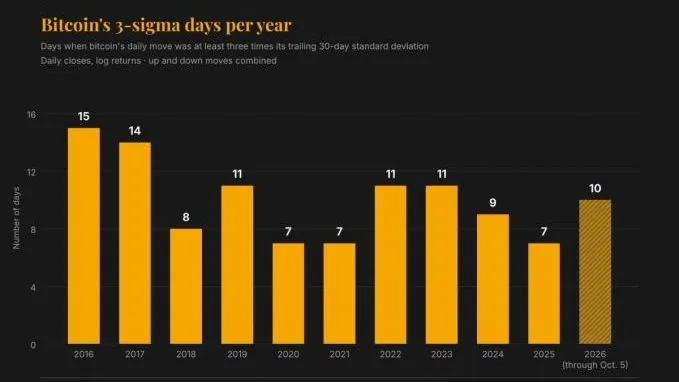
Bitcoin's average volatility has declined significantly, but the frequency of extreme single-day price moves now exceeds 2018 levels, according to recent analysis. The divergence raises questions about how institutional investors measure and hedge tail risk in a maturing market.
Written by CoinArticle’s AI Newsroom · from 2 cited sources. How we work
Volatility Metrics Tell Different Stories
Bitcoin's annualized volatility has fallen, but this headline figure obscures a sharp increase in extreme outlier trading days. CoinDesk analysis identified 10 unusually large trading days in 2026 alone, while Crypto Briefing's data shows these extreme swings now occur more frequently than they did during 2018's bear market. The divergence highlights a structural shift: traditional volatility measures, which average price movements across all days, do not capture the clustering of tail-risk events.
What This Means for Risk Measurement
Institutional investors have long used annualized volatility as a shorthand for portfolio risk. A lower figure typically signals a safer asset. But when extreme moves concentrate into discrete trading days while most days remain calm, standard deviation-based models understate the probability of sudden drawdowns. Traders and hedge funds that rely solely on historical volatility to size positions or set stop-losses face a mismatch between model expectations and realized price action.
The shift also reflects Bitcoin's maturation. With more capital, more venues, and more complex derivatives, liquidity can evaporate faster than it did in 2018, allowing smaller order flow to trigger sharper swings on lower-volume days.
Why It Matters
For Traders
Position sizing and stop-loss placement based on historical volatility may not account for the increased frequency of 10%+ daily moves; risk management models need retuning.
For Investors
A lower volatility regime with higher tail risk frequency suggests Bitcoin's risk-return profile is shifting; diversification assumptions built on 2020-2024 data may no longer hold.
For Builders
Liquidation engines and oracle-fed derivatives protocols should review extreme-move handling; basis risk and cascading liquidations during low-liquidity, high-swing events pose operational risk.
This article is for information only and is not financial advice. Read the full disclaimer.