Coinbase, Strategy and Crypto Stocks Fall After Binance's $6.3B Breach
Crypto equities sold off on Oct. 30 after Binance disclosed a security breach estimated at $6.3 billion, with Coinbase leading losses following its quarterly earnings. Declines ranged from about 4.9% to 12.5% in midday trading, outpacing both Bitcoin and major US equity benchmarks.
Written by CoinArticle’s AI Newsroom · from 2 cited sources. How we work
Crypto Equities Extend Losses
Shares of Coinbase, Strategy, Robinhood and several miners fell sharply on Oct. 30, with Coinbase down as much as 12.54% in midday trading. Market data at about 11:25 a.m. EDT showed declines across nine tracked stocks, ranging from 4.89% for BitMine Immersion Technologies to Coinbase's 12.54%. Several names recovered some ground from their session lows by late morning.
The simple average decline across the nine stocks was approximately 7.48%, with each company weighted equally. Over the same window, Bitcoin fell about 4.65% according to The Defiant, and the S&P 500 dropped 1.24%. Crypto.news put the Bitcoin decline at 5% in a later snapshot, when Bitcoin traded near $77,454 with a session low of $76,460. The two outlets' Bitcoin figures differ because they were measured at different points in the session, so the exact move depends on the timestamp used.
Coinbase's Earnings Backdrop
Coinbase traded at $140.46 at the time of the crypto.news snapshot, down $20.13 from its prior close, after touching $136.93 earlier in the session. The stock's session low sat roughly 14.7% below its previous close of $160.59. Strategy's low of $124.34 represented a decline of about 12.2% from its $141.62 prior close, before it recovered.
The stock move came alongside Coinbase's third-quarter earnings. Transaction revenue was $590.2 million, down 44% from a year earlier and 1% from the prior quarter. Total revenue was $1.216 billion, a 35% annual decline, while net income reached $718.7 million, compared with a $359.5 million loss in the second quarter. Adjusted EBITDA came to $332.9 million.
Within those results, consumer transaction revenue was $450 million, with spot trading volume down 9% and derivatives volume down 6% quarter over quarter. Prediction-market growth offset part of the decline. Institutional transaction revenue fell 8% to $92 million, and subscription and services revenue reached $570.2 million, up 3% sequentially but down 20% year over year.
Binance Breach and Recovery
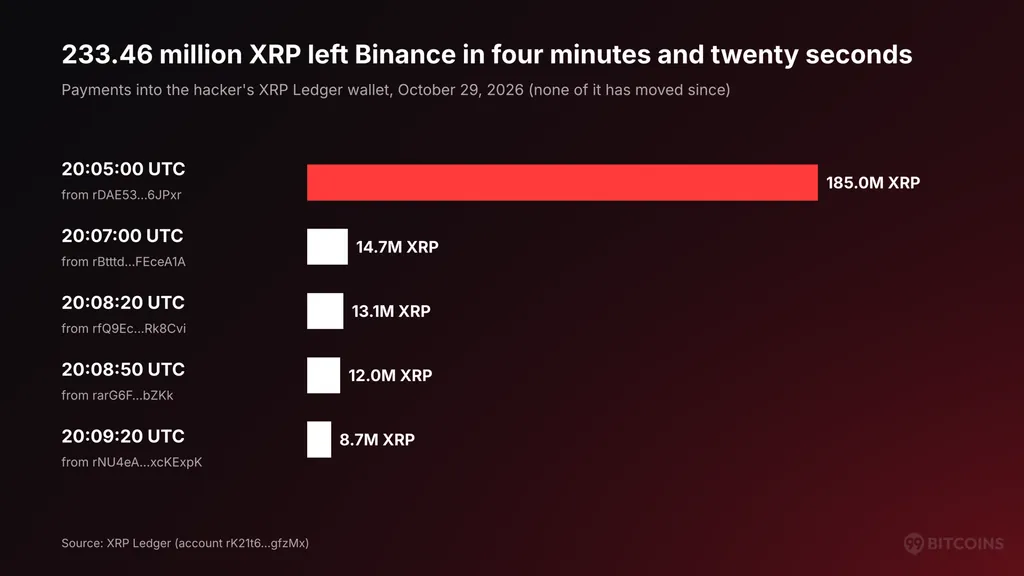
The sell-off followed Binance's Oct. 29 security breach, which the exchange estimated at $6.3 billion. In an Oct. 30 update, Binance said it had reserved more than $6.34 billion of company funds, including $5 billion already held in the affected cryptocurrencies, and that roughly $3 billion had been frozen through industry cooperation separately from those reserves.
Binance has begun buying back stolen altcoins through exchanges and over-the-counter desks. Co-founder Yi He said available holdings included Bitcoin and Ethereum, though the company did not disclose how much of either it would sell. Replacement purchases of some assets could take longer, according to the company's remarks.
Market Read
The reports attribute the decline to a combination of the breach and Coinbase's earnings, and the sources do not isolate the weight of each factor. The equity losses were larger than the moves in the Invesco QQQ Trust, which fell 2.83%, and the SPDR S&P 500 ETF, down 1.36%, but the sources do not establish how much of the gap reflects exchange-specific risk versus broader sector positioning.
Why It Matters
For Traders
Intraday prices in crypto equities diverged widely from their session lows, so entry and exit levels should be checked against live quotes rather than the reported midday figures.
For Investors
A $6.3 billion exchange breach puts counterparty security and reserve adequacy back on the sector's risk checklist, independent of Bitcoin's price direction.
For Builders
Exchange breaches of this scale raise the bar for custody controls, hot-wallet exposure limits and proof-of-reserves disclosures that integrators will increasingly expect.
This article is for information only and is not financial advice. Read the full disclaimer.