Strategy Sells 32 BTC, Its First Sale Since 2022, as Bitcoin Falls Below $66,000
Strategy disclosed in an 8-K filing that it sold 32 BTC between May 26 and May 31, its first bitcoin sale since 2022, to fund preferred stock distributions. Bitcoin fell as much as 10% in early June, and analysts disagree on whether the sale signals structural strain or a manageable balance-sheet move.
Written by CoinArticle’s AI Newsroom · from 7 cited sources. How we work
Story Updates
- Updated Nov 5, 2026, 12:03 AM: Adds Bitcoin Magazine details: $402M liquidations, record ETF outflow streak, $128.3M ATM raise, and 2022 sale comparison.
- Updated Nov 5, 2026, 12:03 AM: Adds Decrypt and Grayscale reporting on MSTR's intraday drop, STRC's $100M monthly cost, and TD Cowen's view on the sale's size.
- Updated Nov 4, 2026, 03:03 PM: CoinDesk analysis adds 2022 comparison; no new sales or filings disclosed beyond the June 1 8-K.
- Updated Nov 4, 2026, 10:01 AM: Adds 8-K sale details, STRC preferred funding mechanics, and CryptoSlate's market and analyst reporting on the sale's structural risk.
- Updated Nov 4, 2026, 09:01 AM: Adds Bitcoinist's report putting the sale at about $2.5 million and framing it as the end of a 3.5-year accumulation streak.
The Sale and Its Stated Purpose
Strategy sold 32 BTC between May 26 and May 31, according to an 8-K filing it submitted on June 1, its first bitcoin sale since December 2022 and a departure from its long-standing stance against selling. The average execution price was $77,135 per coin, bringing in about $2.5 million, and the company said the proceeds were used "to fund distributions on preferred stock." The sold amount represents about 0.0038% of the company's 843,706 BTC holdings, which carry an average cost basis of $75,699.
Chair Michael Saylor had previewed the move on an earnings call last month, saying the company would "probably sell some Bitcoin to pay a dividend just to inoculate the market and send the message that we did it." Strategy also used $1.38 billion in cash reserves to retire $1.5 billion of its 2029 convertible notes at an 8% discount to par, and bought 24,869 BTC with proceeds from a $2 billion STRC offering. Decrypt reported that the purchase drew down corporate cash shortly before a large monthly dividend payout to STRC holders, a timing the outlet tied to the company's roughly $100 million monthly STRC obligations, estimates Decrypt published without company confirmation.
Saylor posted on X that the company is focused on making STRC "the best credit instrument in the world," without addressing the sale directly.
Preferred Funding and the Dividend Model
Strategy has issued several perpetual preferred stocks over the past year, including STRK, STRC, STRF and STRD, to offer fixed-income returns alongside its bitcoin holdings. STRC, introduced in July 2025, is the most widely held and pays monthly cash distributions at an annualized rate of 11.5%, a level held for four consecutive months. Decrypt puts the outstanding flagship preferred at $10.48 billion. The rate is reviewed monthly and can be adjusted to keep the shares near their $100 par value.
That par anchor matters to the funding model. When STRC trades near par, Strategy can issue additional shares through its at-the-market program on more favorable terms to raise capital for bitcoin purchases and dividend obligations. CryptoSlate noted that this makes the treasury a potential funding source for the credit products built around it, which is the structural concern analysts are now weighing.
Saylor said on the Q1 2026 earnings call that bitcoin needs to appreciate about 2.3% per year for existing holdings to cover STRC dividends in perpetuity without issuing common stock, and that the company would buy 10 to 20 bitcoin for every one it sells.
Market Reaction
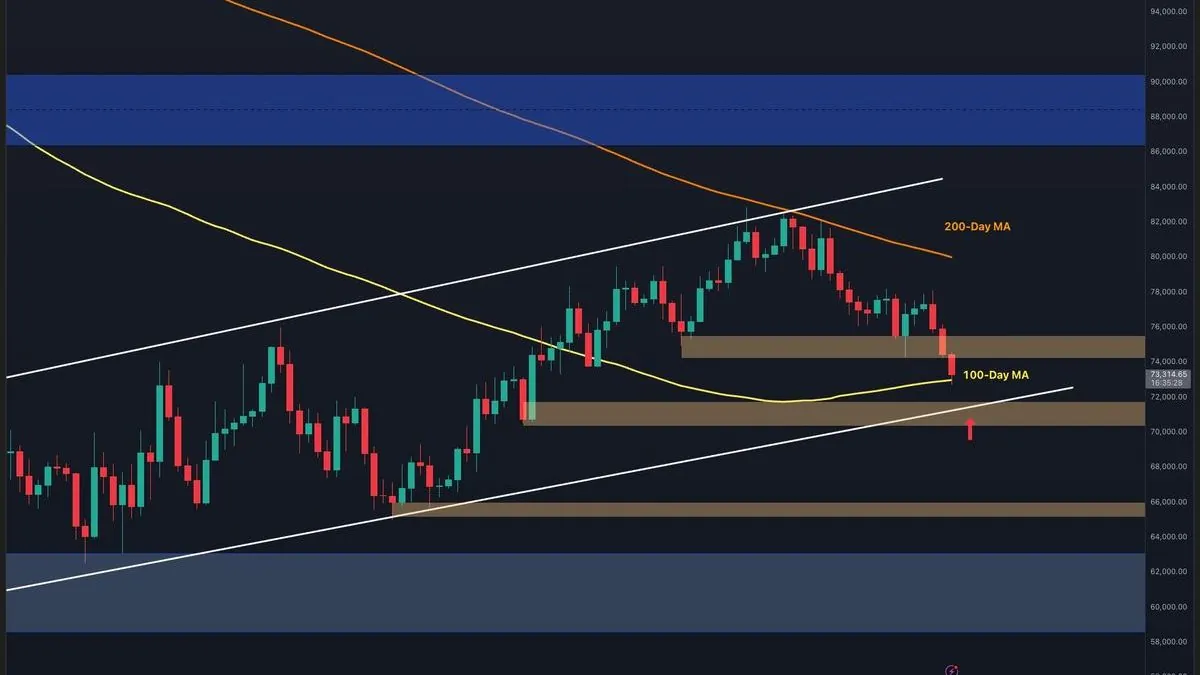
Bitcoin fell roughly 10% in early June, from about $74,000 to around $65,400 at the lows, before recovering toward $70,000 in later reporting. Bitcoin Magazine reported the price slipping below $72,000 after the filing, down nearly 3% over 24 hours. CoinGlass data showed $402 million in 24-hour crypto liquidations across 135,585 traders, including $72.34 million in bitcoin positions, with longs accounting for the majority of the losses.
Strategy's equities and preferred stock also moved. Decrypt reported MSTR shares fell as much as 5.3% to $150.68 on Monday, their lowest level in about six weeks. Yahoo! Finance data cited earlier showed MSTR falling 9.6% from Monday's open to $134 and slipping a further 4% to $130 on Wednesday. STRC traded at $94.84 against its $100 par value. CNBC's Jim Cramer wrote that the sale may force a reevaluation of the pro-bitcoin stance, though he said claims of manipulation were too strong.
Separately, U.S.-listed spot bitcoin ETFs logged a record 10-session outflow streak through May 29, according to the reporting, adding macro pressure to the market at the same time.
Historical Context: How This Sale Differs from 2022
In December 2022, Strategy sold 704 BTC at about $18,000 each and bought back 810 BTC two days later at a lower price, a trade most observers described as a tax-loss move. Some bulls now cite that episode as a possible bottoming signal, though the parallel is not established.
CoinDesk's analysis argues the 2022 sale and the current one are not directly comparable. Strategy has since built a far more complex structure, with a larger stack of preferred instruments, convertible debt and at-the-market equity issuance. The key difference is the funding model: the 2022 position was a conventional holding, while today's holdings are tied to products that must service fixed monthly distributions.
Where Analysts Disagree
Tiger Research senior analyst Ryan Yoon told Decrypt that STRC's discount "signals a structural crack" in Strategy's leverage-heavy model, and that investors feared forced bitcoin sales to service debt, which "shattered the 'never sell' narrative." Crypto economist Alex Kruger called the sequence "tragicomic" and argued the firm was "cornered" and should have sold a larger amount if it intended to sell at all.
TD Cowen analyst Lance Vitanza wrote that the sale is negligible against a stockpile of 843,706 BTC, worth roughly $60 billion, and that headlines suggesting a meaningful reduction are misleading. He kept his $400 MSTR price target unchanged.
Bitrue Research Institute research lead Andri Fauzan Adziima described the moves as fundamentally sound balance-sheet decisions that were poorly timed during a macro-sensitive dip. He acknowledged the STRC discount raises the cost of preferred funding and pushes Strategy toward equity issuance or further bitcoin sales, but characterized most institutional views as "navigable leverage friction rather than a death spiral," and expects stabilization around $65,000 to $68,000.
Grayscale head of research Zach Pandl told Decrypt that a smaller share of bitcoin supply held by digital asset treasuries may be positive for the longer-term outlook, noting that bitcoin produces no cash flows, so sales were eventually inevitable to cover dividend obligations. None of these views can yet be tested against further filings or price action.
What to Watch
The key open questions are how Strategy funds its next dividend obligations, whether it issues more equity or sells additional bitcoin, and whether STRC returns toward its $100 par value. Strategy also reported raising $128.3 million through its at-the-market common stock program last week, with about $26.1 billion remaining under that program, and held $900 million in USD cash as of May 31. Saylor's remark that the sale was meant to "inoculate the market" raises the question of whether further sales are planned. Future 8-K filings will be the primary independent confirmation, since on-chain data can only show transfers from wallets the company has publicly identified.
Why It Matters
For Traders
STRC trading below its $100 par and continued ETF outflows keep near-term sentiment fragile, so watch the next monthly distribution and any new 8-K disclosures.
For Investors
The sale is small relative to holdings, but it marks a shift in how the largest corporate bitcoin treasury may fund itself, making its preferred-funding model a central risk factor.
For Builders
Products that depend on Strategy's preferred pricing or treasury behavior should model scenarios where STRC trades below par and equity issuance or bitcoin sales become necessary.
This article is for information only and is not financial advice. Read the full disclaimer.