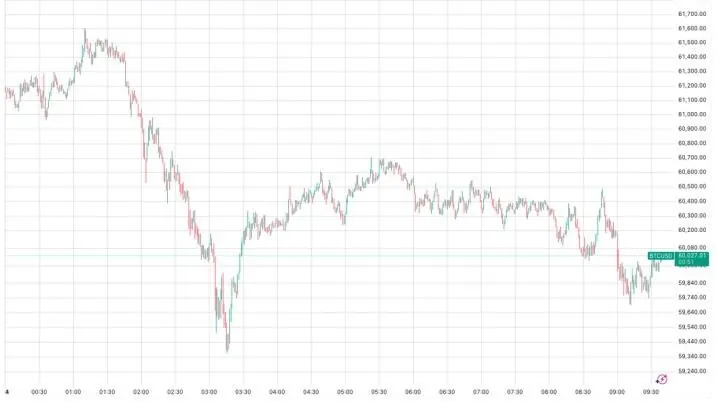
Bitcoin Falls Below $60,000 as Fed December Hike Debate and ETF Outflows Weigh
Bitcoin dropped below $60,000 on Friday for the first time since July, as US spot Bitcoin ETFs recorded net withdrawals and the Federal Reserve weighed a possible larger December rate increase. The Fed's December 9 decision and the November CPI release the following morning are expected to shape near-term price action.
Written by CoinArticle’s AI Newsroom · from 2 cited sources. How we work
Price Breaks $60,000
Bitcoin traded below $60,000 on Friday for the first time since July. CryptoSlate reported a price near $59,470 during the US session, down from about $61,900 early in the day, as technology stocks also declined. CoinDesk, in a separate report, tied the move to a fading rally after Nvidia's return earlier in the week, noting that Nasdaq 100 futures fell about 1% after the index surged on Monday and that the Dollar Index held above 104, its highest level since March 2025. The two outlets emphasize different drivers, with CryptoSlate focusing on Fed policy expectations and CoinDesk on the reversal in equities and the stronger dollar.
ETF Outflows and Competing Yields
US spot Bitcoin ETFs recorded $582.3 million in net outflows on November 19, according to Farside Investors, with BlackRock's IBIT accounting for $541.1 million of that total. CryptoSlate put cumulative withdrawals from US spot Bitcoin ETFs at $3.47 billion over the period it covered. Those flows matter because the funds had helped bring institutional demand into the asset, and their withdrawals coincided with the break below $60,000. Short-term Treasury bills were offering investors more than 4% annually, giving holders a yield alternative to a non-yielding asset.
The December Fed Decision
The Federal Reserve held its target range at 3.75% to 4.00% in October. Governors Lisa Cook and Beth Hammack voted for a quarter-point increase, while Governor Christopher Waller sided with the majority to wait, arguing that markets already expected tightening and the Fed could hold for one meeting without changing the outlook. Traders as of November 18 priced in a quarter-point increase in December, according to futures-implied odds cited by UOB in a November 19 research note, which put the chance of an additional quarter point at roughly 7.6%. Those figures reflect market pricing at a point in time, not a formal vote count or Fed guidance.
Waller has since argued for a larger move. In a speech before the October CPI release, he said officials should consider a 50-basis-point increase in December if core CPI kept rising about 0.3% a month. The October figures met that threshold, with core CPI up 0.3%, the third consecutive monthly gain of that size. In a November 18 television interview, he said the Fed should either deliver the larger move or pair a quarter-point increase with a clear signal that further tightening would follow. The October meeting minutes, also released November 18, show that a couple of unnamed participants had raised the possibility of more than 25 basis points in December if inflation ran hot. The minutes do not identify them, so the discussion cannot be attributed to Waller.
Calendar and Rate Scenarios
The December meeting runs December 8 to 9, with the decision and new projections due December 9. November CPI follows on December 10, which means markets will price the Fed's inflation outlook before the data that tests it. Officials will also see October PCE data on November 25, the inflation gauge used for the 2% target, and the November jobs report on December 4. A 25-basis-point move would lift the target range to 4.00% to 4.25%; a 50-basis-point move would take it to 4.25% to 4.50%. Analysts will be watching whether a larger hike simply pulls forward a planned January increase or whether it signals a higher peak rate, since the two outcomes would likely affect longer-term yields differently.
Market Read
The sources agree on the core picture: a break below $60,000, sizable ETF outflows, and a Fed decision that has become more contested. They diverge on what drove the most recent leg lower, with one outlet centering Fed expectations and the other centering the equity reversal and dollar strength. Both explanations can be true at once, and neither has been confirmed as the primary cause by a single data source.
Why It Matters
For Traders
Bitcoin's break below $60,000 sets up a potentially volatile window around the December 9 Fed decision and the December 10 CPI release.
For Investors
A shift toward a larger Fed hike or a higher peak rate would change the opportunity cost of holding non-yielding assets like Bitcoin relative to Treasury bills.
For Builders
Continued ETF outflow data and rate-path volatility make real-time flow and macro-event monitoring a more important input for products tied to Bitcoin exposure.
This article is for information only and is not financial advice. Read the full disclaimer.