Democratic Midterm Sweep Pushes Bitcoin Below $77,000 as Clarity Act Outlook Shifts
Bitcoin fell to roughly $76,700 after early U.S. midterm projections indicated Democrats would win both chambers of Congress. The result raises questions about the future of the Clarity Act, which Democrats unanimously blocked in September, though analysts say SEC and CFTC rulemaking could still provide some regulatory clarity.
Written by CoinArticle’s AI Newsroom · from 2 cited sources. How we work
Price Action on Election Night
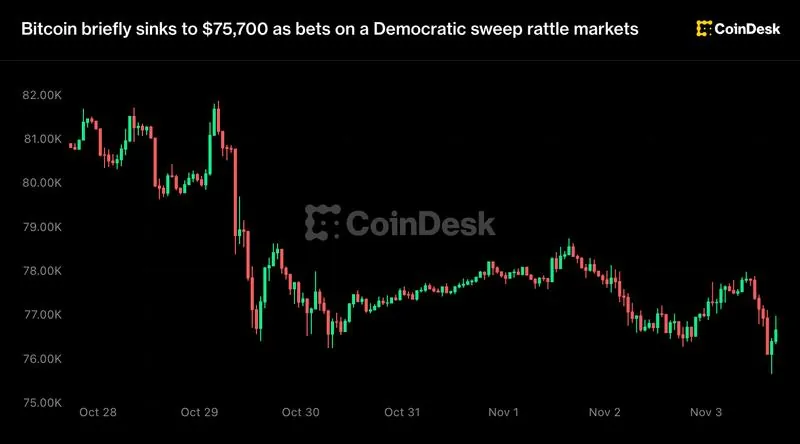
Bitcoin traded as low as $75,700 on Tuesday as early U.S. midterm returns pointed toward a Democratic sweep, according to CoinDesk. CryptoPotato put the post-result level at $76,700, and the two figures reflect different points in the same evening's decline rather than a disagreement over the close. Stock futures and the U.S. dollar also weakened while Treasuries rallied, a pattern CoinDesk described as a broader risk-off reaction to the outcome.
Congressional Projections
NBC News, cited by CryptoPotato, projected Democrats at 51 Senate seats, a majority up from 45 seats plus two independents caucusing with Democrats in the prior term. In the House, the projected final tally is 244 Democratic seats to 191 Republican seats, with Democrats flipping 30 Republican-held seats. Among the Senate changes, Democrat Roy Cooper is projected to win the North Carolina seat previously held by Senator Thom Tillis, one of the few Republicans who voted against the Clarity Act in September. Cooper has previously supported clear and stable regulation for the crypto sector.
Implications for the Clarity Act
Democrats voted unanimously in September to block the Clarity Act, a bill negotiated to define how crypto companies operate and how digital assets are split between securities and commodities. The sweep means that the bill's prospects in the current Congress are uncertain, and reporting from both outlets frames the vote as a setback for the industry. Existing lawmakers have also signaled new oversight priorities. Representative Robert Garcia, set to chair the House Oversight Committee, has said he intends to investigate "Trump family corruption," which he includes the family's crypto ventures such as the TRUMP token.
Regulatory Pathways That Remain
CryptoPotato reports that several analysts still expect practical clarity to come from the Securities and Exchange Commission and the Commodity Futures Trading Commission, which can issue and amend rules without legislation. The limitation is that agency rules do not carry the durability of statute and can shift between administrations. Decrypt's Tyler D, quoted by CryptoPotato, described the first-order impact as manageable and said the sector's momentum was unlikely to be stopped by one election cycle.
Political Context
Daily Wire commentator Matt Walsh, quoted by CryptoPotato, characterized the result as a backlash against President Donald Trump's policies, including the cost of living and foreign policy, although Trump was not on the ballot. The sources differ on emphasis: CryptoPotato frames the sell-off primarily as a reaction to a party historically hostile to crypto, while CoinDesk attributes it to bets on a Democratic sweep that had been priced in before results were confirmed. Neither source reports a figure for how much of the decline was attributable to the election specifically.
Why It Matters
For Traders
Bitcoin's move below $77,000 reflects a sharp reaction to midterm projections, and near-term price direction may depend on how the market prices the next policy signals from Congress.
For Investors
A Democratic-controlled Congress lowers the odds of the Clarity Act passing soon, so regulatory clarity may depend more on SEC and CFTC rulemaking that can be reversed by future administrations.
For Builders
Rulemaking from the SEC and CFTC rather than statute raises the chance that compliance requirements change with each administration, so teams should design products to adapt to shifting agency guidance.
This article is for information only and is not financial advice. Read the full disclaimer.