Ethereum Holds Near $2,100 as Analysts Split on Whether Correction Has Ended
Ether is trading in the $2,080 to $2,230 range, with sources disagreeing on the current price and on whether the pullback from the $4,800 high is complete. Technical analysts flag $1,800 as the key downside level and $2,400 as the level that would change the medium-term outlook.
Written by CoinArticle’s AI Newsroom · from 2 cited sources. How we work
Price Levels and Where the Sources Diverge
Ether is trading between roughly $2,080 and $2,230, depending on the source and timestamp. CryptoPotato reported ETH at $2,080 with the price drifting lower, while Bitcoinist put it near $2,230, roughly flat over the past week despite a broader crypto sell-off. The gap is consistent with the articles being written at different points in the same session rather than a true disagreement on direction, but readers should treat the exact figure as time-sensitive.
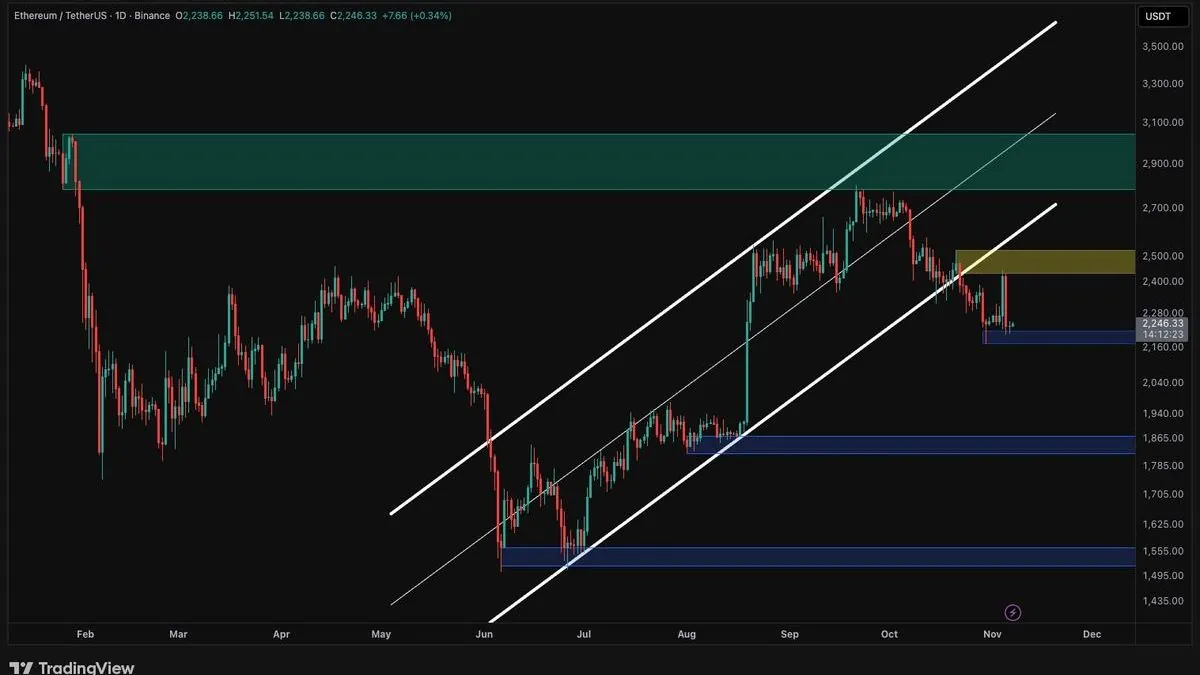
Both sources agree on the broad range of the drawdown. Ether peaked near $4,800 and has since retraced, with the mid-May rejection from the $2,400 area marking a turning point for CryptoPotato's daily chart.
Technical Setup: Bearish Daily, Possible Reversal on the 4-Hour
CryptoPotato's daily-chart analysis is cautious. The 100-day moving average, near $2,200, is acting as resistance, and the lower boundary of an ascending channel is barely holding. RSI has fallen into the 35 to 40 range, which indicates selling pressure without reaching oversold territory. The author identifies $1,800 as the primary downside reference, roughly $280 below current prices, and $2,400 as the level that would have to be reclaimed to shift the mid-term narrative.
The same article describes a potential inverse head-and-shoulders on the 4-hour chart, with a neckline near $2,150. A 4-hour close above that neckline would be the trigger for a rebound toward $2,250 or higher, while a break below $2,000 would invalidate the pattern. Pattern-based setups of this kind are interpretive, and the source presents it as a conditional scenario rather than a forecast.
Bitcoinist frames the setup differently. It argues that ETH is holding a key support zone and that whales are accumulating during the dip, and it draws a comparison to a 2025 price fractal, suggesting the correction may already be complete. That is a more constructive read than CryptoPotato's, and the two articles do not reconcile on whether the structure is still deteriorating or has bottomed.
On-Chain Supply and Whale Activity
CryptoPotato reports exchange reserves of 14.8 million ETH, near the lowest level in several years. The author notes that reserves rose from 14.4 million in early May, a modest increase that could signal holders moving supply back to exchanges. Read as a sell-side indicator, low exchange reserves suggest limited immediate supply, though the source cautions that the rise bears watching.
Bitcoinist's whale-accumulation claim rests on the same general thesis that large holders are buying the dip. The two accounts are compatible on supply thinness but differ in emphasis: one stresses reserve levels as a potential support factor, the other stresses active buying by large addresses. Neither source, as summarized here, provides a verifiable wallet-level dataset for the whale claim, so it should be weighted accordingly.
What Would Change the Picture
The two articles converge on the same levels to watch. A sustained move above the 100-day moving average near $2,200 is the minimum needed to stabilize the daily structure. Reclaiming $2,400 would shift the medium-term picture. On the downside, a failure of the $2,000 area opens a path toward $1,800, the demand zone both sources identify as the next meaningful support.
Why It Matters
For Traders
Watch whether ETH closes a 4-hour candle above roughly $2,150 or loses $2,000, since the sources map those as the two near-term triggers.
For Investors
Ether's medium-term trend hinges on reclaiming $2,400, and analysts disagree on whether the correction is already complete.
For Builders
Thin exchange reserves and shifting staking and supply dynamics may matter for protocols that depend on ETH liquidity assumptions.
This article is for information only and is not financial advice. Read the full disclaimer.