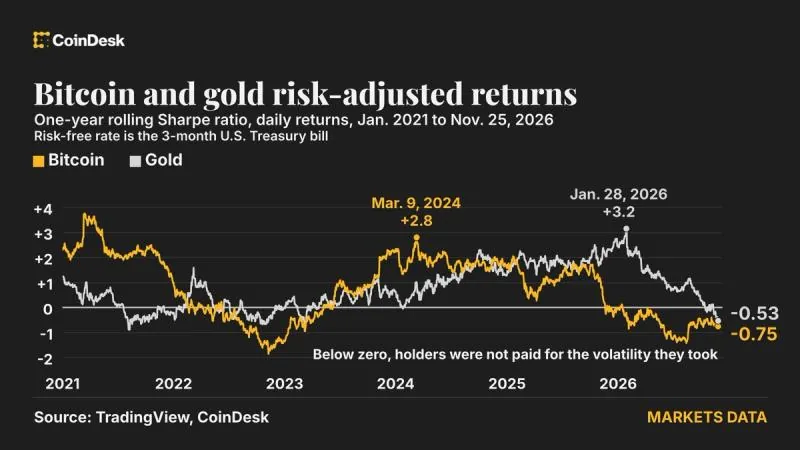
Gold Loses Risk-Adjusted Edge Over Bitcoin as Fed Turns Hawkish
Gold has lost the risk-adjusted advantage it held over Bitcoin for most of the past year, according to CoinDesk, as a stronger dollar and rising rate-hike bets weigh on non-yielding assets. Both assets now show negative one-year Sharpe ratios, though gold still leads over three- and five-year horizons.
Written by CoinArticle’s AI Newsroom · from 2 cited sources. How we work
Gold's Advantage Erodes
Gold has lost the risk-adjusted lead it held over Bitcoin for most of the past year, according to CoinDesk. Both assets now carry negative one-year Sharpe ratios, meaning neither has delivered returns that compensate for the volatility holders endured. Gold has fallen roughly 33-36% from its January 2026 high of approximately $5,600 per ounce and now trades between $3,500 and $3,800.
Bitcoin has also declined. It peaked above $126,000 in October 2025 and currently trades between $60,000 and $68,000. The Bitcoin-to-gold ratio has climbed above its 200-day moving average, a signal that Bitcoin has recently outperformed the metal on a relative basis.
The Fed and Real Yields
The main driver is a shift in monetary policy expectations. Markets are pricing a 95-97% probability of a 25-basis-point Fed rate hike in December 2026. US two-year real yields have risen above 2.4%, their highest level since 2023.
Both gold and Bitcoin pay no yield, so higher real returns on government bonds raise the opportunity cost of holding them. A stronger dollar adds pressure, since both assets are typically priced in dollars.
Where the Sources Differ
The two accounts agree on the direction of the shift but frame its scope differently. CoinDesk's analysis puts the lost edge in terms of one-year risk-adjusted returns and notes that gold still leads over three- and five-year horizons. Crypto Briefing's summary, drawing on the same reporting, emphasizes the same longer-horizon caveat, so the distinction is one of emphasis rather than conflicting figures. Neither source disputes the price ranges cited, though the reporting does not establish a single consensus figure for the exact Sharpe values.
Flows and Structural Support
Bitcoin's relative gain owes more to gold's weakness than to new inflows. Spot Bitcoin exchange-traded funds recorded substantial net outflows recently, including roughly $570 million leaving on a single day in late November. Gold, by contrast, retains a structural buyer: central banks continue to accumulate the metal, providing a fundamental demand floor that Bitcoin does not have.
Indicators to Watch
The December Fed decision and the subsequent path of real yields are the key variables. The Bitcoin-to-gold ratio holding above its 200-day moving average would suggest Bitcoin's relative strength is durable, while a slip below it would return the narrative to gold. A return to steady spot Bitcoin ETF inflows would indicate recovering institutional appetite, while sustained outflows would weaken the case that Bitcoin is advancing on its own merits.
Why It Matters
For Traders
The December Fed decision and the Bitcoin-to-gold ratio's position against its 200-day average are the near-term markers to track as rate-hike pricing develops.
For Investors
Gold's loss of risk-adjusted advantage over shorter horizons, paired with its continued lead over three to five years, points to a regime where real yields dominate relative performance.
For Builders
Rising real yields and dollar strength are reshaping how crypto assets are benchmarked against traditional stores of value, which matters for any product pricing or hedging against gold.
This article is for information only and is not financial advice. Read the full disclaimer.