Online Casino Infrastructure: The Tech Behind Seamless Gaming
Modern online casinos rely on sophisticated technical infrastructure including redundant servers, encryption protocols, and real-time data systems to ensure seamless gameplay and financial security. Understanding these backend systems reveals key performance indicators for traders, competitive advantages for investors, and architectural lessons for developers in mission-critical applications.
Written by CoinArticle’s AI Newsroom · from 1 cited source. How we work
The Real Structure Supporting Seamless Online Casino Gameplay
Infrastructure Demands in Modern Gaming
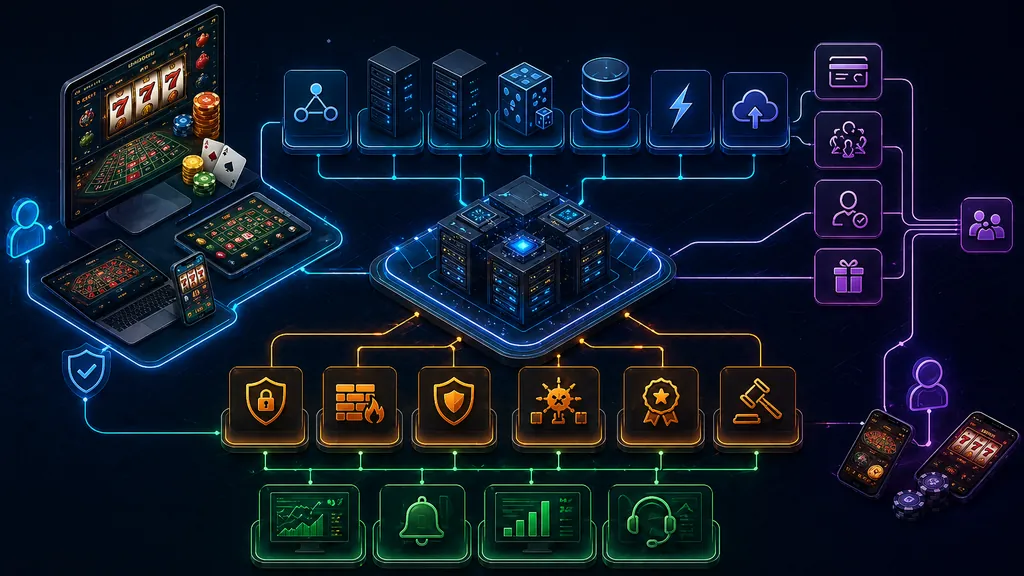
The online casino industry operates within an exacting technical environment where milliseconds determine user satisfaction and trust. Behind every spin, hand deal, and betting action lies a sophisticated network of interconnected systems designed to handle simultaneous transactions across millions of users globally. Players demand smooth gameplay with zero lag, making infrastructure investment non-negotiable for operators seeking competitive advantage.
Online casino sites have evolved far beyond simple software applications. Today's platforms require redundant server networks, distributed computing architectures, and real-time data synchronization across multiple geographic regions. This technical complexity directly impacts player retention rates and operational costs.
Financial Security and Game Integrity
Operators must implement strict measures for financial transactions to protect both players and their own business models. Multi-layered encryption protocols, secure payment gateways, and compliance with international regulatory standards form the backbone of trustworthy casino operations. These aren't optional features—they're foundational requirements.
Game integrity protection is a critical requirement that demands constant technological vigilance. Random number generators must undergo rigorous third-party audits, and transaction logs require immutable verification systems. The integration of blockchain technology in some platforms represents an evolution in this space, offering transparent verification mechanisms that benefit both operators and players.
The Balancing Act: Load Distribution and Player Analytics
A network of highly designed systems maintains balance in online casino operations. Load balancing technology distributes traffic efficiently, preventing server overload during peak usage periods. Sophisticated monitoring systems track player behavior patterns, identifying irregularities that could indicate fraud or problem gambling.
Operators also manage algorithmic payout structures that maintain profitability while ensuring players experience wins at psychologically meaningful frequencies. This balance between mathematical house advantage and player satisfaction requires continuous optimization and real-time adjustments.
Why It Matters
For Traders
Understanding the infrastructure requirements of online casino operators reveals capital expenditure needs and operational efficiency as key performance indicators; companies investing heavily in technology infrastructure demonstrate superior customer retention metrics and revenue stability.
For Investors
The technical moat created by superior infrastructure represents a significant competitive advantage, enabling operators with robust, scalable systems to capture market share more effectively while maintaining lower customer acquisition costs through positive reputation and reduced technical issues.
For Builders
The online casino sector demonstrates how mission-critical applications require redundancy, security, and real-time performance simultaneously, providing valuable architectural lessons for developers working in fintech, payment processing, and gaming infrastructure.
Conclusion
The online casino industry ultimately illustrates that sustainable growth requires investing in the unsexy but essential infrastructure that users never notice—until it fails. Superior technical architecture directly translates to competitive advantage, player trust, and long-term profitability.
This article is for information only and is not financial advice. Read the full disclaimer.