Visa Expands Stablecoin Settlement Pilot to Nine Blockchains at $7B Run Rate
Visa said its stablecoin settlement pilot now supports nine blockchains after adding Arc, Base, Canton, Polygon and Tempo, with an annualized settlement run rate of $7 billion. The company described the work as settlement infrastructure for issuers and acquirers rather than a consumer checkout product.
Written by CoinArticle’s AI Newsroom · from 2 cited sources. How we work
What Visa Announced
Visa said on April 29 that its stablecoin settlement pilot now runs on nine blockchains and has reached an annualized settlement run rate of $7 billion, according to CryptoSlate's report of the company's statement. The company added Arc, Base, Canton, Polygon and Tempo to a pilot that already used Avalanche, Ethereum, Solana and Stellar. Bitcoinist, reporting on the same press release, also described the expansion as adding five new blockchains, including Arc and Polygon, and framed the pilot as enabling issuers and acquirers to settle using stablecoins.
Both outlets rely on the same underlying figures. Visa stated that the annualized run rate rose 50% from the prior quarter. Neither the company's disclosure nor the coverage breaks the $7 billion figure down by chain, stablecoin, partner or geography, so the volume distribution across the nine networks cannot be determined from available material.
Where Stablecoins Sit in the Payment Stack
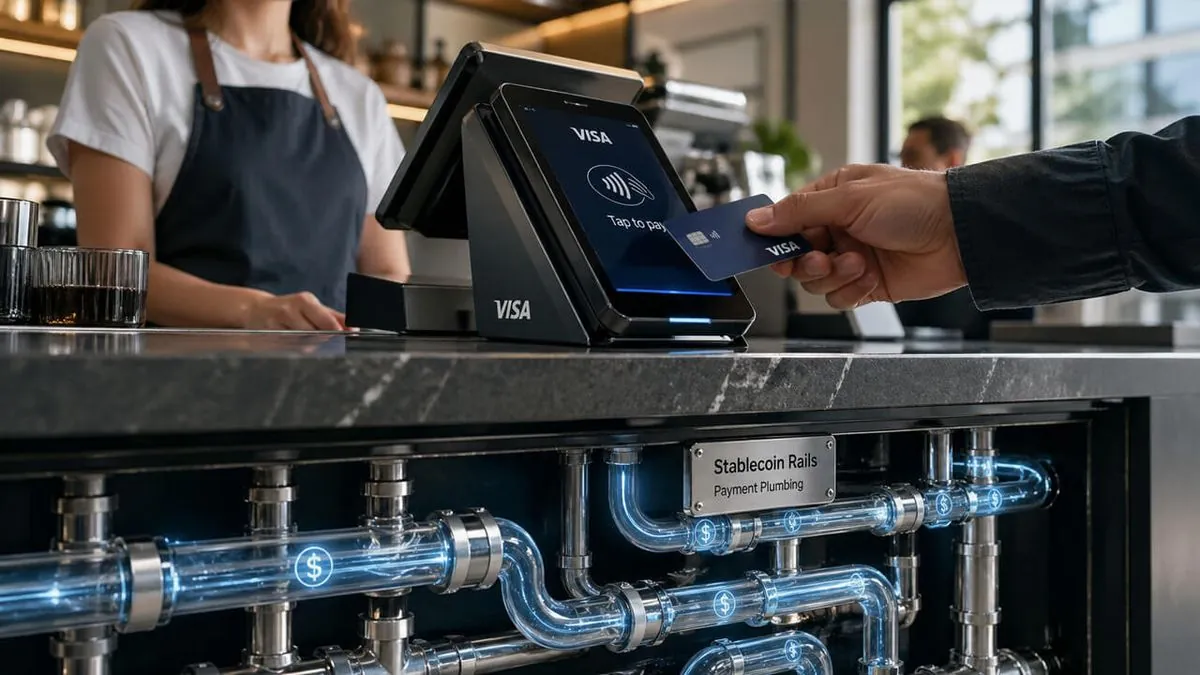
The significance lies in the layer being targeted. Authorization at the point of sale is near-instant, but the movement of funds between an issuing bank and a merchant's bank happens afterward, through settlement systems that move value across institutions and currencies. Visa's stablecoin work sits in that back-office process rather than at the checkout screen. CryptoSlate characterized the update as a settlement-infrastructure signal, a reading that follows from the company's own framing of a settlement pilot.
The pilot is optional alongside traditional settlement. The available disclosures describe added rails, not a replacement of existing settlement, and the company has not provided a breakdown that would show how much of the $7 billion represents substitution versus new activity.
Build-Up Since 2023
Visa's stablecoin settlement work has developed over several years. In 2023 the company said it had moved millions of USDC between partners over Solana and Ethereum to settle fiat-denominated VisaNet payments, following an earlier Crypto.com issuer pilot and expanding to acquirers Worldpay and Nuvei. In December 2025, U.S. issuer and acquirer partners gained the ability to settle with Visa in USDC, with Cross River Bank and Lead Bank initially settling over Solana. Visa cited faster funds movement, seven-day availability, and resilience across weekends and holidays as reasons for the change.
CryptoSlate places the December 2025 launch at a prior annualized baseline above $3.5 billion, which would imply the run rate roughly doubled to reach $7 billion by April. This comparison depends on that baseline figure, which the material attributes to CryptoSlate's reading of the earlier announcement rather than a direct Visa restatement in the sources provided.
Card Programs and the Five New Chains
The April release tied the chain expansion to Visa's stablecoin-linked card programs, which the company said number more than 130 across more than 50 countries. CryptoSlate read the nine-chain footprint as part of an operating model for partners rather than a ledger experiment.
CryptoSlate described Arc as a stablecoin-native Layer 1 created by Circle, offering USDC-denominated fees, optional privacy, sub-second deterministic finality and direct integration with Circle's stack. The outlet presented these properties as relevant to payment flows where predictable costs and transfer guarantees matter more than speculative token activity. The sources do not provide comparable technical detail for the other four added networks.
Why It Matters
For Traders
The $7 billion run rate is an annualized pilot figure with no chain-level breakdown, so it should not be read as a direct demand signal for any single token in the next few days.
For Investors
Visa moving stablecoins into settlement infrastructure across nine networks is a structural signal that incumbent payment rails are integrating crypto as an operating option.
For Builders
Stablecoin-native chains such as Arc and integrations with issuers like Circle are becoming settlement targets, so teams should evaluate how USDC liquidity and finality guarantees fit their payment flows.
This article is for information only and is not financial advice. Read the full disclaimer.