XRP Ledger Volume Hits Records as Sources Split on What Drives It
XRP Ledger transaction counts rose 65% over twelve months to 71 million, per Evernorth, while CryptoSlate reported XRP-paired trading volume nearly doubled in a single week to $62.6 million per DefiLlama. The two figures measure different things, and the underlying data does not show whether the activity reflects new net demand.
Written by CoinArticle’s AI Newsroom · from 2 cited sources. How we work
Two Different Volume Measures
Transaction counts on the XRP Ledger rose 65% over the past twelve months, from 43 million to 71 million, according to a post on X by Evernorth, a digital asset treasury firm focused on XRP. Evernorth presented the figure as evidence of steady, programmatic use by businesses rather than speculative bursts.
A separate measure points in a different direction in magnitude. CryptoSlate, citing DefiLlama daily data, reported XRP-paired trading on the ledger at $62.6 million for November 9 to 15, up 99.9% from $31.3 million the prior week. That series combines automated market maker swaps with order-book trades, and CryptoSlate noted that repeated turnover can recycle existing inventory without establishing fresh net buying. The two sources are measuring different things over different windows, so their growth rates are not directly comparable.
Who Is Transacting
Evernorth named Bitstamp, the regulated exchange, and Ripple's RLUSD stablecoin among the top drivers of the transaction surge, alongside Justoken, VERT, and Braza Bank, a Brazilian institution settling cross-border payments on the ledger. The firm's framing is that exchanges, stablecoin issuers, DeFi protocols and a bank are all settling on the same infrastructure. Evernorth is a holder of XRP and has a commercial interest in that narrative, and the post did not include a public breakdown of how many of the 71 million transactions each named participant accounted for.
Execution Costs for Large Sales
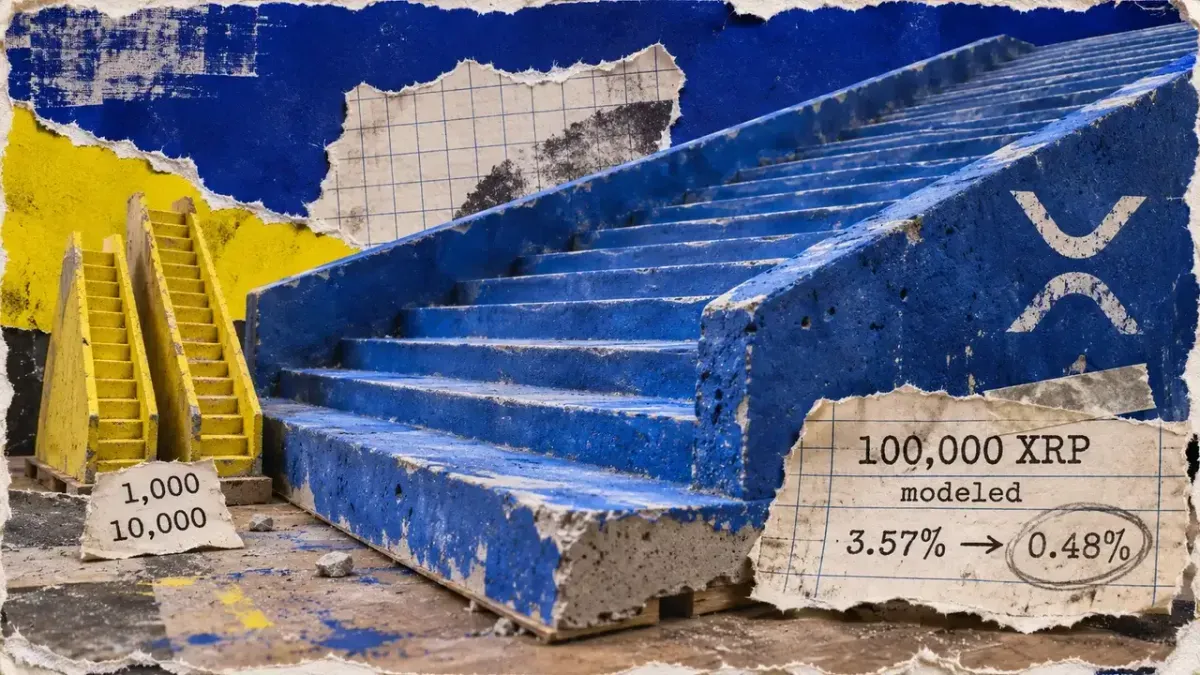
CryptoSlate's modeling focused on the cost of selling XRP into RLUSD liquidity. Using a static model built from capped order-book samples and one automated market maker, it estimated the execution shortfall for a 100,000 XRP sale narrowed from 3.57% on the November 9 ledger close to 0.48% on November 16. Smaller trades moved the other way: the 1,000 XRP shortfall widened from 0.05% to 0.11%, and the 10,000 XRP shortfall widened from 0.05% to 0.19%.
CryptoSlate cautioned that these are estimates, not pathfinding results or completed fills, and that the sample covered at most 100 offers per side within 10% of the reference midpoint. Because XRP itself fell in price between the two snapshots, the same 100,000 XRP sale returned fewer RLUSD dollars on November 16 despite the smaller relative penalty.
Reconciling the Readings
The sources do not contradict each other on any single figure, but they support different conclusions. Evernorth's ledger transaction count describes activity breadth over a year. CryptoSlate's volume figure describes a short-term spike that may reflect turnover rather than new buying, and its execution analysis suggests liquidity for large sales improved in one week while smaller-order costs did not. Neither source measured net accumulation by holders, and neither established whether the institutional settlement activity cited by Evernorth is the main contributor to the weekly volume spike CryptoSlate reported.
Why It Matters
For Traders
Weekly XRP-paired volume spikes can reflect inventory recycling rather than fresh demand, so the data alone does not indicate net direction over the next few days.
For Investors
A year-long rise in ledger transactions points to broader network use, but without holder-level data it is unclear how much of that use translates into durable value capture.
For Builders
Improved RLUSD order-book depth lowered modeled costs for large XRP sales, while smaller trades got slightly worse, so routing and liquidity assumptions should be tested by order size.
This article is for information only and is not financial advice. Read the full disclaimer.