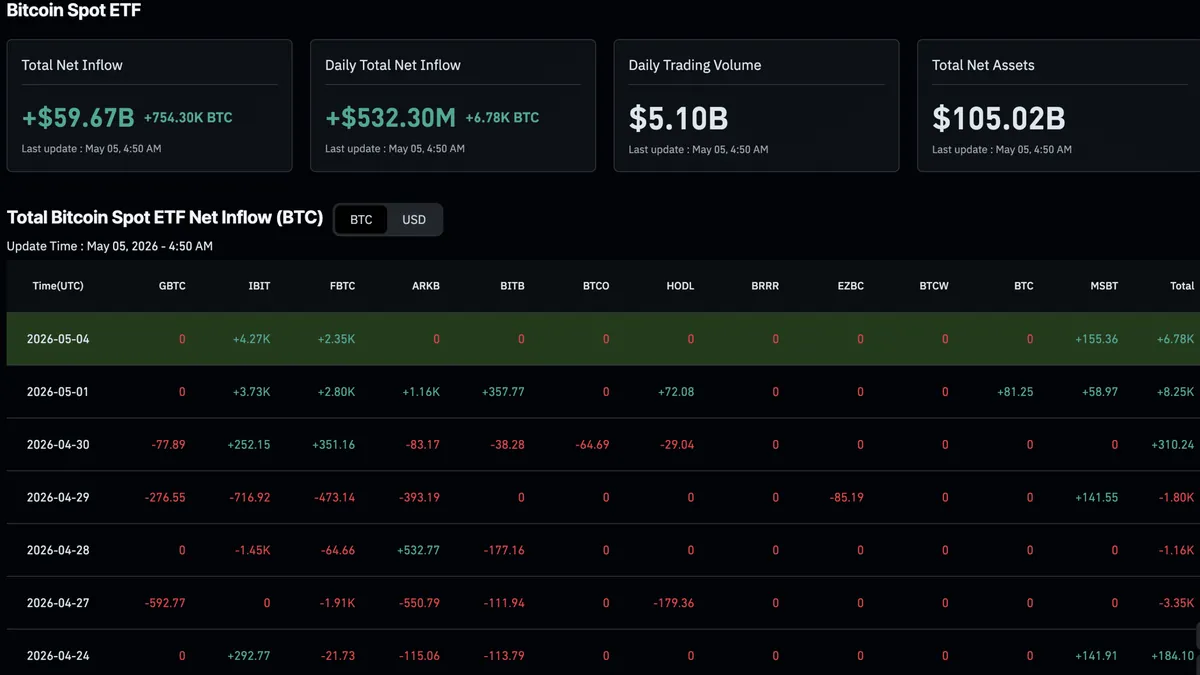
Bitcoin ETFs Pass $58 Billion in Cumulative Net Inflows as Institutional Buying Persists
Spot Bitcoin ETFs have recorded five consecutive weeks of net inflows, with cumulative net flows reported above $58 billion. Sources differ on total net assets, with one reporting $108.76 billion and the other not stating a comparable figure, so readers should treat asset-level totals as unsettled.
Written by CoinArticle’s AI Newsroom · from 2 cited sources. How we work
Cumulative Flows and the Five-Week Streak
Spot Bitcoin ETFs have recorded five consecutive weeks of net inflows, according to Decrypt's reporting. The same period is covered by 99Bitcoins, which reports cumulative net flows across the products crossing $58 billion.
The two accounts describe the same trend but frame it differently. Decrypt emphasizes the streak itself, while 99Bitcoins focuses on the cumulative total since launch and on why large holders have not been reducing their positions.
Net Assets: Where the Sources Diverge
Decrypt reports spot Bitcoin ETFs holding $108.76 billion in net assets. The 99Bitcoins piece does not give a matching net-asset figure, so the two outlets cannot be reconciled on this point from the material available. Cumulative net inflows and total net assets measure different things: inflows are the running sum of new money, while net assets reflect that money plus or minus market price moves, so a $58 billion inflow total and a $108.76 billion asset base are not contradictory on their face.
Readers should not assume either figure is the sole authoritative number without checking a primary data source such as issuer filings or a dedicated flow tracker.
Options Positioning and Hedging
Decrypt links the inflow streak to a fading of put skew, which it describes as a sign that hedging demand has unwound. Put skew measures how expensive downside protection is relative to upside calls, so a decline in skew suggests investors are paying less for protection against a drop in price.
This interpretation is Decrypt's read of the options data. It is not presented as a direct statement from ETF issuers, and it should be weighed as analysis rather than confirmed fact.
Why Holders Are Not Selling
99Bitcoins argues that institutional holders have stayed in their positions rather than redeeming, and frames this as a central reason the inflow total has grown. The piece attributes this to a longer-horizon allocation approach among large allocators, though the underlying holder-level data behind that claim is not detailed in the material provided.
The absence of large redemptions is consistent with the reported inflow streak, but the two sources do not provide holder-level breakdowns that would confirm the motive.
What to Watch Next
The key open questions are whether the five-week streak extends, whether the net-asset figures can be reconciled against issuer disclosures, and whether options skew continues to decline. Each of these would clarify whether the recent flows reflect a sustained shift or a shorter-term rebalance.
Why It Matters
For Traders
A five-week inflow streak alongside fading put skew suggests reduced demand for downside hedges, but the two sources disagree on asset totals, so confirm current flow data before sizing any exposure.
For Investors
Cumulative inflows above $58 billion point to sustained institutional allocation into spot Bitcoin ETFs, a structural signal worth tracking over multiple quarters.
For Builders
Continued ETF inflows increase the volume of custodial and creation-redemption activity that ETF-adjacent infrastructure must handle, so review capacity and reporting assumptions.
This article is for information only and is not financial advice. Read the full disclaimer.