Bitcoin Heads Toward First Back-to-Back Annual Loss as 2026 Trades Down 16%
Bitcoin is down about 16% year to date in 2026 after finishing 2025 down roughly 6%, which would make 2026 its first consecutive losing calendar year if it stays below its opening price. Analysts note that the combined loss is far smaller than past bear-market drawdowns, though both sources caution that the peak-to-trough decline has exceeded 50%.
Written by CoinArticle’s AI Newsroom · from 2 cited sources. How we work
The Streak in Numbers
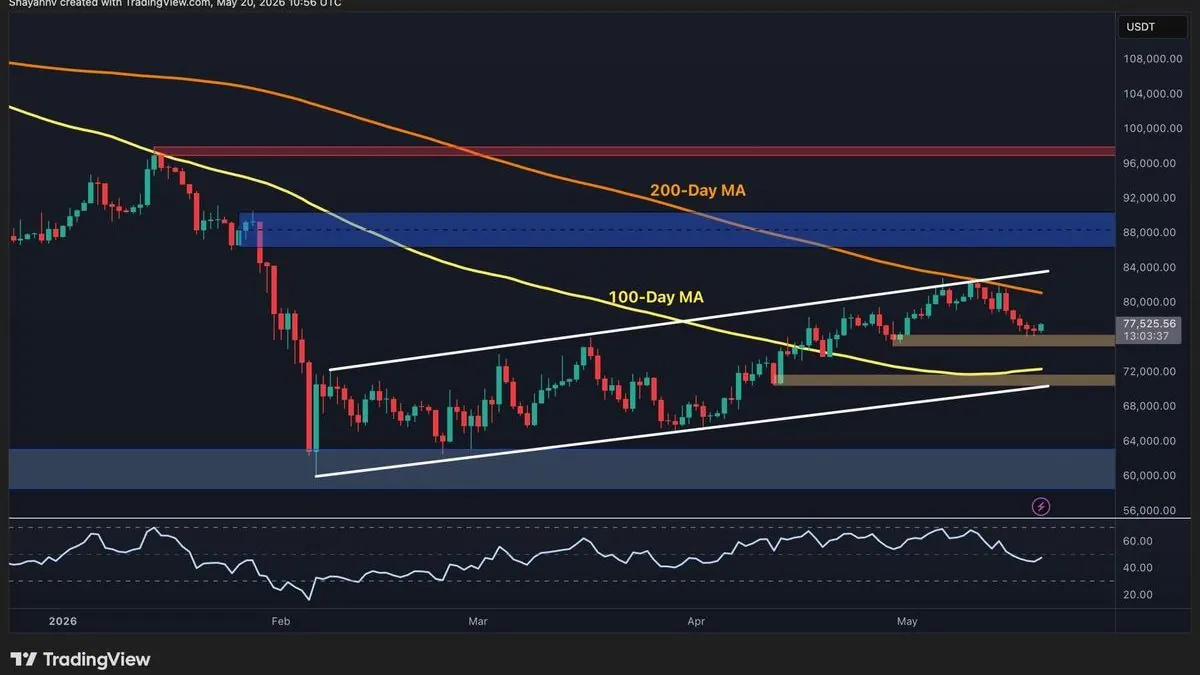
Bitcoin would close two consecutive calendar years in negative territory for the first time in its 18-year history if it finishes 2026 below its opening price of roughly $87,500. Decrypt reported the asset finished 2025 down 6.34% and was trading near $73,850 on November 10, down about 15.65% for the year to that point. Bitcoin Magazine put the 2026 decline at about 16% with seven weeks left in the year, citing its own yearly candle analysis.
To finish 2026 positive, Bitcoin would need to rally roughly 18% from the November 10 level. Both outlets describe the arithmetic the same way, though they round the figures differently, so the exact required gain depends on the reference price used.
Smaller Losses Than Past Crashes
Decrypt argues the streak is less severe than its label suggests. Bitcoin fell 73.56% in 2018 and 64.27% in 2022, while the 2025 and 2026 declines compound to roughly 21% combined. Bitcoin Magazine makes a similar point, noting that 2025 was the first red year directly after a halving and that the current bear market has been shorter and shallower than earlier cycles.
Both outlets also point to the 2024 gain of more than 120% as context for investors who entered at the start of that year. Decrypt notes that Bitcoin previously rebounded after bad years, rising about 92% in 2019 after its 2018 collapse and more than 155% in 2023 after 2022.
Peak-to-Trough Drawdown
The calendar-year framing understates the decline for anyone who bought near the top. Decrypt reports Bitcoin reached roughly $126,000 in October 2025 before falling below $58,000 during 2026, a drop of more than 50%. Bitcoin Magazine's analysis focuses on the annual candles and does not dispute the peak-to-trough figure, so the two pieces are measuring different things rather than contradicting each other.
Analysts cited by Decrypt attribute the smaller calendar-year losses to a larger institutional investor base, spot exchange-traded funds and deeper liquidity. Bitcoin Magazine argues the ETF inflows pulled much of the cycle's rally forward into earlier periods, which it sees as a structural difference from the 2021 cycle. Neither source treats these explanations as settled.
What Would Change the Picture
Decrypt frames a third straight down year in 2027 as a hypothetical scenario, not a forecast. Bitcoin Magazine's chart of the day argues that even a red 2026 would be the mildest post-peak year in prior cycles, though that comparison rests on a small number of historical cycles and should be read with that limit in mind.
Why It Matters
For Traders
Bitcoin needs roughly an 18% rally from November 10 levels to avoid a second red year, so the calendar-year threshold near $87,500 is a reference point for year-end positioning.
For Investors
Smaller calendar-year losses than past cycles suggest a maturing market, but the 50%-plus peak-to-trough decline shows drawdowns remain severe for those who bought near the top.
For Builders
Growing institutional and ETF participation appears to be changing how Bitcoin draws down, which may matter for products that assume historical volatility patterns.
This article is for information only and is not financial advice. Read the full disclaimer.