Bitcoin Holds Near $80K-$82K as ETF Inflows Offset Technical Resistance and CLARITY Act Lobbying Heats Up
Bitcoin is trading in an $80,000 to $82,000 range, with U.S. spot ETFs posting roughly $1.9 billion in April net inflows and nine consecutive days of inflows through early May. Analysts flag resistance near $82,000 to $84,000 and a $76,000 support level, while banks are lobbying against stablecoin yield provisions in the CLARITY Act ahead of a Senate markup.
Written by CoinArticle’s AI Newsroom · from 2 cited sources. How we work
Price Action and Technical Levels
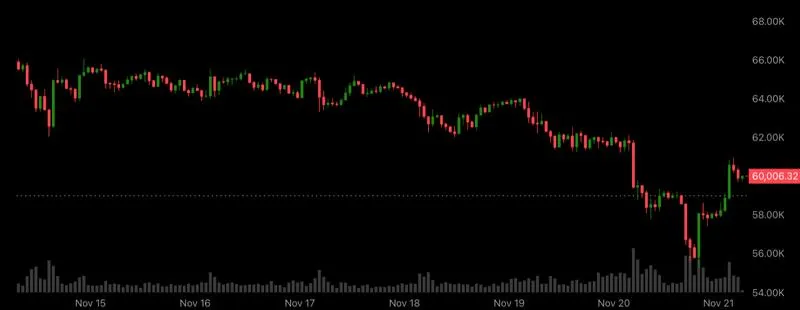
Bitcoin has traded mostly between $80,000 and $82,000 over the past week, according to Bitcoin Magazine, which put the price near $82,000 at time of writing, up about 0.65% from Sunday morning. CryptoPotato's analysis placed the asset around $80,000, a difference that reflects the timing of each report rather than a disagreement on the level itself. Both sources describe the coin as roughly 22% below its level a year earlier and well below the October 2025 peak above $126,000.
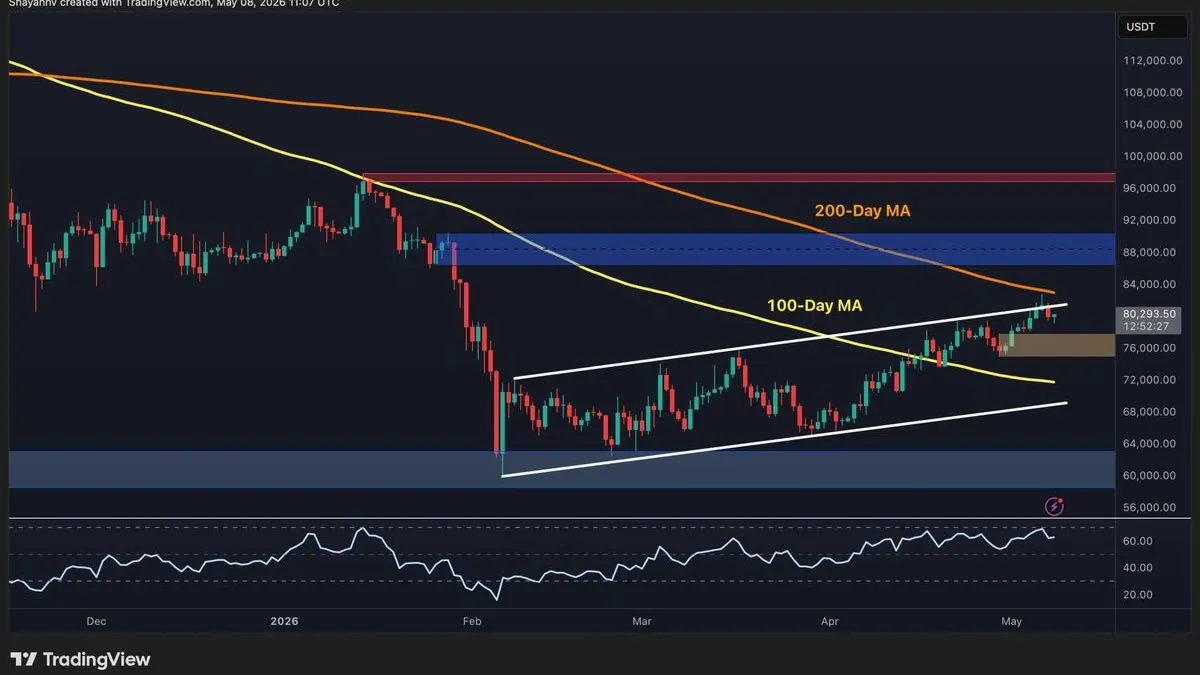
CryptoPotato's technical read identifies the ascending channel as intact, with the 100-day moving average, near $72,000, reclaimed and holding. The publication flags the $82,000 area, where the channel's upper boundary meets static resistance, as the zone where recent rallies were rejected. The next resistance band it cites sits between $88,000 and $90,000, with the 200-day moving average, descending near $84,000, described as the harder test. On the downside, it identifies $79,000 as a yellow trendline from early April and $76,000 as an order block whose loss would signal a failed move.
CryptoPotato also notes that the 4-hour RSI fell from an overbought peak to around 50, a sign of weakening short-term momentum. Its daily-chart RSI, by contrast, sits in the 60 to 65 range, which it reads as healthy momentum without excess. Readers should note that these levels come from a single analyst's charting and are not confirmed by any exchange or protocol data.
Funding Rates and the Shape of the Rally
CryptoPotato argues that the rally from roughly $60,000 to $80,000 unfolded almost entirely under negative perpetual futures funding rates, which it reports ran between -0.005 and -0.02 from February through early May. In its reading, the move was driven by short covering and spot buying rather than new leveraged longs, which it considers structurally healthier because there is less leverage to unwind on a pullback. The current funding reading of +0.002 is the first sustained move toward neutral since the correction began, which the publication interprets as traders shifting from short to long positioning.
Bitcoin Magazine does not dispute the broad sequence but frames demand differently, attributing the recent stability to institutional flows rather than derivatives positioning. The two sources therefore agree on the direction of the rally while emphasizing different drivers.
ETF Flows and Supply Dynamics
Bitcoin Magazine reports that U.S. spot Bitcoin ETFs drew about $1.9 billion of net inflows in April, the strongest month since October 2025 and enough to turn year-to-date flows positive. It puts cumulative inflows since the products launched in 2024 near $58 billion, with the funds holding more than 1.3 million BTC. It also reports nine consecutive days of net inflows through early May totaling about $2.7 billion, which it estimates removed 33,000 to 35,000 BTC from tradable supply. The bulk of that demand concentrated in BlackRock's IBIT and Fidelity's FBTC.
The publication's supply estimate is its own calculation from flow data and should be treated as an estimate. CryptoPotato does not address ETF flows, so the institutional-demand thesis rests on a single source.
CLARITY Act and the Stablecoin Yield Fight
Regulation has become a price factor alongside flows, according to Bitcoin Magazine. The CLARITY Act, a market-structure bill that would divide jurisdiction over most digital assets between the SEC and CFTC, is approaching a markup in the Senate Banking Committee, with a floor vote targeted for summer after a compromise over stablecoin yield. The bill follows last year's GENIUS Act, which set a July 2026 deadline for follow-on stablecoin rules.
On Sunday, the American Bankers Association launched a lobbying push against the bill ahead of Thursday's markup. In a letter to member banks, ABA CEO Rob Nichols argued that the stablecoin yield provisions could move deposits out of traditional banks and threaten financial stability. Coinbase Chief Legal Officer Paul Grewal responded that banks had already won concessions in prior White House negotiations, and Senator Bernie Moreno accused banks of trying to kill innovation and said he would support advancing the bill. Bitcoin Magazine also reports that the White House is developing a Strategic Bitcoin Reserve framework for managing seized coins without direct budget outlays. The outcome of the markup and the framework's form remain unresolved.
What to Watch
The two sources point to the same near-term question: whether the $82,000 area can be cleared on sustained ETF demand. CryptoPotato's levels suggest a break below $76,000 would shift the technical picture, while the CLARITY Act markup and any Reserve framework could add a regulatory catalyst within weeks.
Why It Matters
For Traders
The $82,000 resistance and $76,000 support are the levels analysts are watching, and the stablecoin yield fight could bring volatility around Thursday's Senate Banking Committee markup.
For Investors
Sustained ETF inflows and a potential CLARITY Act framework point to growing institutional and regulatory integration, though the bill's final form remains uncertain.
For Builders
Stablecoin yield provisions in the CLARITY Act could reshape how payment stablecoin products are designed and how they compete with bank deposits.
This article is for information only and is not financial advice. Read the full disclaimer.