Buterin Backs Slowing AI Data Center Growth to Buy Time for Security Defenses
Ethereum co-founder Vitalik Buterin defended opposition to large AI data centers in a November 8 post, arguing a slower buildout would cost science little while giving society time to harden cyber and biological defenses. The comments land as Bitcoin miners Riot Platforms and Cipher Digital expand into AI hosting.
Written by CoinArticle’s AI Newsroom · from 2 cited sources. How we work
Buterin's Argument on Algorithmic Efficiency
Ethereum co-founder Vitalik Buterin said in a November 8 post that opposition to new AI data centers is a reasonable position and that he disagrees with the strong emotional reaction against anti-data-center movements seen that week. His central claim rests on algorithmic progress: he argued that software improvements could let existing computing facilities perform tasks that would otherwise require much larger centers, suggesting capabilities needing bigger facilities in two years could be achievable with today's infrastructure within four years, or sooner.
Buterin did not call for shutting down existing facilities or propose a specific government ban. He wrote that "nothing remotely apocalyptically bad will happen from even extreme levels of success by anti-data-center people," and that "a slowdown in compute hyper-scaling seems quite net good."
The Cost-Benefit Case for a Slowdown
Buterin's second argument concerns what a slowdown would cost science. According to his post, many constraints on scientific progress are not compute problems: running experiments, gathering data and testing results take time regardless of available GPUs. On that basis, he argued that a one-year slowdown in AI scaling would not delay scientific advances by a comparable one-year amount, while giving society room to strengthen cybersecurity and reduce biological risks from increasingly capable systems.
He framed the case without relying on artificial general intelligence posing existential risk, a more contested claim. The argument is instead that defenses should be ready before the technology outpaces them.
Buterin's Earlier Comments on AI and Cryptography
Buterin's November remarks build on two earlier posts. In October 2026 he warned that AI advances could significantly weaken lattice-based cryptography within two years and recommended larger parameters in cryptographic practice. In September 2026 he highlighted AI's potential to strengthen security through formal verification of entire programs rather than only hunting individual bugs. Taken together, the posts describe AI as both a near-term threat to cryptographic assumptions and a tool for stronger defenses, with a slower compute buildout giving the defensive side time to mature.
Bitcoin Miners Move Into AI Hosting
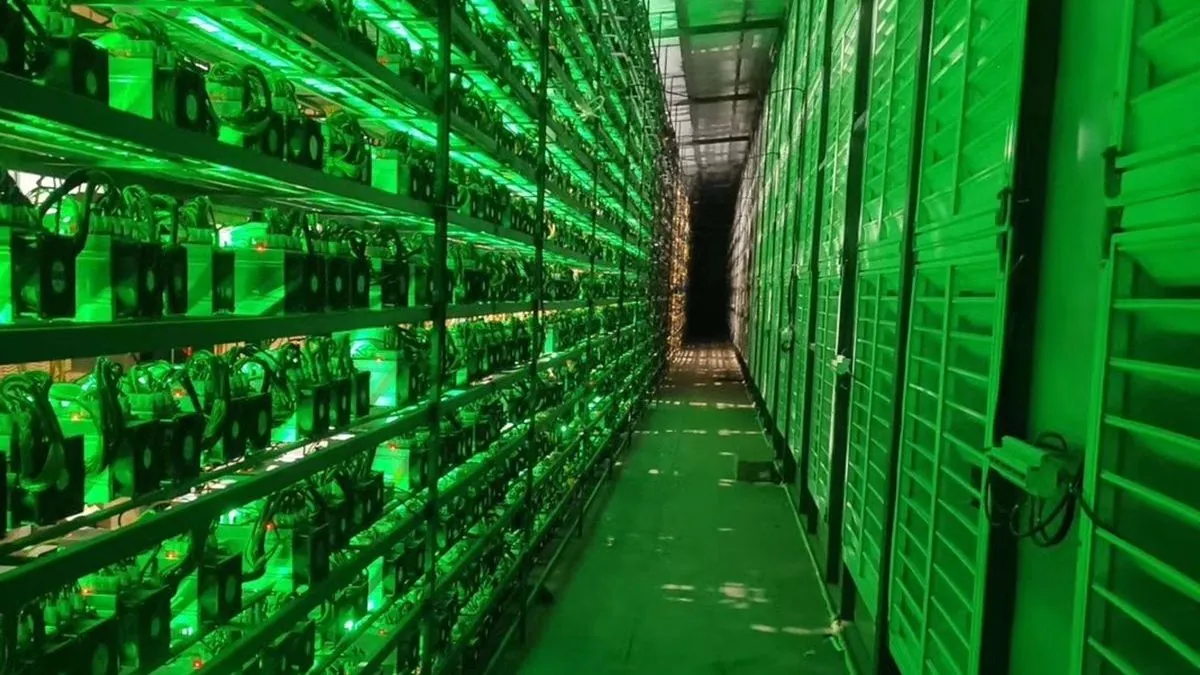
The debate arrives as publicly traded Bitcoin miners expand into AI infrastructure, using existing land, power connections and computing capacity. Riot Platforms reported on November 4 that it signed a 15-year lease covering 910 megawatts of critical computing capacity at its Corsicana facility in Texas, with an estimated $28 billion in contracted revenue over the initial term. Including other leases, Riot said its contracted data center capacity reached 1,151 megawatts, or approximately $38 billion in long-term revenue. Riot also said it sold 20,264 Bitcoin in the first nine months of 2026, raising about $1.5 billion, primarily to fund data center development.
Cipher Digital reported in its November 2 earnings release its first high-performance-computing lease revenue after rent payments began at its Black Pearl site. It extended its Barber Lake lease to 20 years, bringing expected contracted revenue from that site to approximately $9.1 billion, and reported a development pipeline of roughly 5.9 gigawatts.
Local Opposition and Open Questions
Texas has become a focal point of opposition to new data centers, particularly among communities concerned about electricity costs, water use and the pace of development. Neither source reports a specific policy action tied to Buterin's comments, and his post does not propose one. The sources do not say how the miners' expansions would be affected by a broader slowdown in hyperscale construction.
Why It Matters
For Traders
Bitcoin miners' AI hosting contracts are now a larger share of their valuations, so exposure to power and data center policy debates matters more than hash rate alone.
For Investors
Long-term miner revenue is shifting toward multi-decade AI leases, which could reshape how public miners are valued relative to Bitcoin price.
For Builders
Buterin's October warning gives protocol and wallet developers a concrete reason to review lattice-based cryptography parameters on a short timeline.
This article is for information only and is not financial advice. Read the full disclaimer.