Democratic Midterm Sweep Fails to Derail Bitcoin, Clarity Act Faces Delay
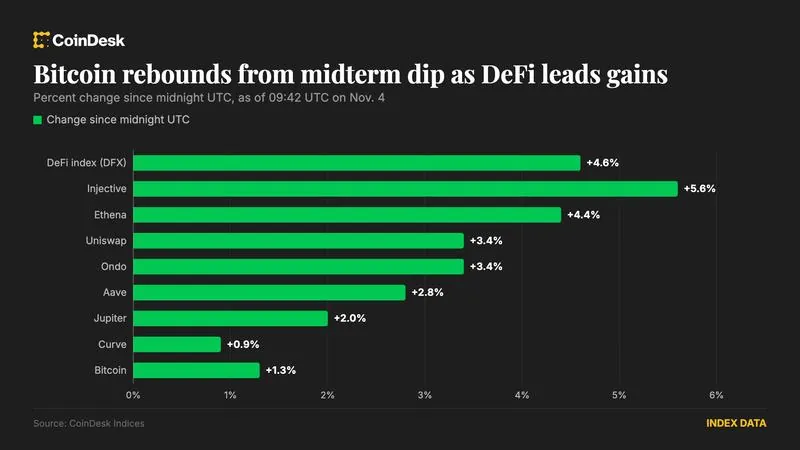
Democrats flipped both the U.S. House and Senate in the 2026 midterms, a result that weighs on the Clarity Act's prospects. Bitcoin rose 1.6% over 24 hours to $78,277 after a brief intraday dip, with analysts saying the outcome was largely priced in.
Written by CoinArticle’s AI Newsroom · from 2 cited sources. How we work
Bitcoin's Intraday Reaction
Bitcoin traded at $78,277 after rising 1.6% over the past 24 hours, according to Decrypt data, following a brief dip when the midterm results came in. Almost every top-100 token by market capitalization was also higher on the day. The Bitcoinist report framed the market move as a possible setup for a Bitcoin comeback, while Decrypt's account emphasized how quickly prices recovered from the intraday low.
The two outlets describe the magnitude of the initial dip differently. Bitcoinist characterized the move as a notable shift in market sentiment, while Decrypt described only a brief drop, with a V-shaped recovery over the course of the day. Neither source published an exact intraday low, so the size of the dip cannot be confirmed from the reporting.
Why Analysts Say the Result Was Priced In
Polymarket odds for a Democratic sweep of both chambers stood at 65.5% at the start of the week, according to Decrypt. André Dragosch, head of research at Bitwise Europe, said that probability meant markets were not surprised by Tuesday's results, and that sentiment had already been bearish going in. James Butterfill, head of research at CoinShares, said the anticipated outcome "need not trigger another sell-off" and could clear uncertainty for a relief rally.
Bitcoinist attributed the market reaction to a different set of drivers, and the two accounts do not fully reconcile on how much of the move reflected the election outcome versus broader market conditions. Decrypt's sources consistently pointed to pricing in advance as the main reason for the muted response.
Regulatory Outlook and the Clarity Act
The midterm result increases uncertainty around the Clarity Act, a market-structure bill introduced in 2025 that has stalled amid opposition from many Democrats over Trump family crypto conflicts of interest. Dmitry Machikhin, CEO of BitOK, predicted the bill will remain in limbo into 2027. Butterfill said CLARITY "faces a harder path" and that investigations into Trump-linked ventures could consume political capital.
Sources agree that the result does not reverse existing pro-crypto rules. Dragosch said Democrats cannot roll back guidance already issued by the SEC and CFTC, and Butterfill noted that GENIUS, the stablecoin framework, remains in place. Tim Sun, senior analyst at HashKey, said the market can no longer rely as heavily on Trump's "political tailwinds for momentum."
Heslin Kim, co-founder and CBO of Zenith, argued that crypto policy did not decide the midterms, which turned instead on the economy, gas prices, the Iran situation and Trump's unmet promises. Kim added that the sector now carries reputational costs tied to Trump-family activity.
Sector Exposure and Longer-Term Outlook
Butterfill expects U.S. exchanges, token issuers and businesses that depend on new regulatory permissions to be more sensitive to the result than Bitcoin itself. He said compliant operators could benefit if scrutiny falls mainly on weaker competitors. Marcin Kaźmierczak, co-founder and COO of RedStone, said a Democratic Congress could be healthy for the industry because crypto infrastructure should function regardless of which party holds power.
Dragosch expects limited legislative change over the next two years, describing more disputes and disagreements but no halt to the sector's progress. Neither source offered a timeline for when the Clarity Act might next advance.
Why It Matters
For Traders
Bitcoin's quick recovery suggests the midterm result was largely priced in, so near-term price action may hinge more on macro conditions than on the election outcome.
For Investors
A Democratic-controlled Congress lowers the odds of Clarity Act passage before 2027, extending the period of regulatory ambiguity for U.S.-facing crypto businesses.
For Builders
Existing SEC, CFTC and GENIUS rules remain in force, so compliance work built on current guidance should not be stranded by the election, though market-structure rules remain unsettled.
This article is for information only and is not financial advice. Read the full disclaimer.