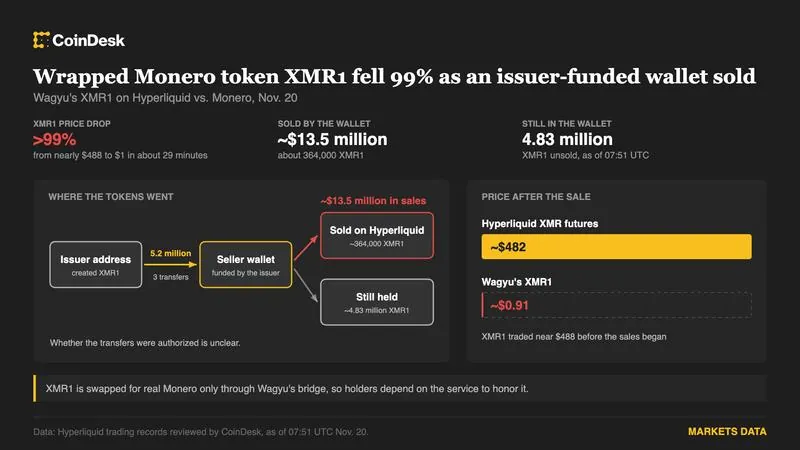
Wrapped Monero Token XMR1 Falls 99% After $13.5M Sell-Off From Issuer-Linked Wallet
The wrapped Monero token XMR1, issued through Wagyu, fell about 99% on Hyperliquid after a single wallet sold roughly $13.5 million of it on Nov. 20. The Wagyu operator has pledged refunds to market makers while blaming a compromised hosting provider for exposing the token's deployer key.
Written by CoinArticle’s AI Newsroom · from 4 cited sources. How we work
Story Updates
- Updated Nov 21, 2026, 05:08 PM: Adds Bitcoinist's 99.8% decline figure, deployer-account attribution, and reiterates that refund and redemption details remain unconfirmed.
- Updated Nov 20, 2026, 05:48 PM: Decrypt reports the sold proceeds were converted to ETH, the sale was tied to a deployer-key drain, and the host's own statement confirms a cyberattack.
The Sell-Off and Price Collapse
The wrapped Monero token XMR1 fell about 99% on Hyperliquid on Nov. 20 after a wallet linked to its issuer sold tokens worth an estimated $13.5 million, according to Bitquery's on-chain analysis. Bitquery traced 5.2 million XMR1 to a receiving wallet in three transfers on Friday, which then sold 363,804 tokens to 388 buying accounts between 04:49 and 07:42 UTC. Crypto.news reported the decline at 99.8%, while CoinDesk reported 99%; the figures differ on the precise magnitude but agree the token lost nearly all of its value. By Bitquery's account, the price dropped from around $500 to $1 in roughly half an hour. Bitcoinist, in a separate report, described the drop as 99.8% and said the wallet was linked to the token's deployer account.
Bitquery found that about 76% of the proceeds arrived in the first 11 minutes of selling, and one account alone paid $3.56 million as the seller filled buy orders already resting near the old price. By 08:00 UTC the wallet had sold only 7% of the tokens it received, with roughly 315,000 still listed mostly at $1. The $13.5 million figure is Bitquery's tally of what buyers paid, not a figure reported by the operator. Decrypt, citing the same Bitquery analysis, reported that the proceeds were converted to ETH, with about 7,350 ETH still held in three wallets at its last check.
Hyperliquid's separate XMR futures market was not part of the sell-off. Those contracts were trading near $482 after the selloff, according to Crypto.news.
Wagyu's Account and the Hosting Breach
PerpetualCow, the pseudonymous operator behind Wagyu, said in posts on X that XMR1 market makers bore most of the losses and that customers who used Wagyu to swap tokens suffered none. In a later post, the operator said the key to the account that issued XMR1 had been stored on a server rented from Icelandic hosting provider 1984 ehf. PerpetualCow said that server had already been deleted but believed the host had retained files and logs from it, writing that such providers "keep your data/logs even after you delete your server."
Icelandic outlet DV published a joint statement from 1984 and the national cybersecurity response team CERT-IS, which said the company had suffered an extensive and serious cyberattack on its IT infrastructure. Early findings pointed to a well-organized and technically sophisticated attack, and the company said it could not rule out that more systems were affected than it had confirmed. It temporarily shut down all services and said email and DNS would be restored first under special monitoring. The statement did not mention Wagyu or whether customer data was taken.
The accounts are not fully aligned. PerpetualCow's claim about the deployer key rests on the operator's own statement, while Bitquery said the blockchain records show which account sent the tokens but cannot establish who used its key or whether the key was stolen. No independent source has confirmed that the deployer key was exposed through the breach. Decrypt also reported that the attacker's account received its first funds from the Tornado Cash mixer minutes before it was set up, and that the same deployer account still controls nearly all of ZEC1, a Zcash token. Wagyu had disclosed a separate data leak in October, saying at the time that funds were unaffected.
Refunds, Redemption and Open Questions
PerpetualCow promised full refunds to market makers who lost money and said anyone who took a loss would be reimbursed personally. The posts gave no payment schedule or claim process, and the operator said Wagyu would relaunch at an unspecified later date. Asked for a timeline, the operator said only, "Give me some time please." In its first update, the operator had said it would negotiate with whoever was behind the sales.
Wagyu's bridge documentation, dated Nov. 12, describes XMR1 as the token users receive on Hyperliquid when depositing native Monero, and says the service also handles redemption back to XMR. Those terms list a 0.01 XMR minimum in both directions, free deposits and a 2% withdrawal fee, and allow each direction to be switched on or off independently. PerpetualCow's Friday updates did not say whether redemption remained open during the sell-off, leaving holders' ability to exit to native Monero unconfirmed. Bitquery also said it cannot see how much Monero backs the remaining XMR1, since the Monero side of the bridge is not visible on-chain. Native Monero itself was not affected by the exploit.
The issuer had also appeared in a separate investigation earlier in the week. On Nov. 16, crypto.news reported that researcher Specter had traced roughly $1.2 million from a suspected Gnosis Safe theft to a conversion into Monero through Wagyu. That report is unrelated to the XMR1 sell-off on the record available.
Why It Matters
For Traders
XMR1 holders face unresolved redemption status and an unverified Monero backing, so exposure should be treated as near-total loss risk until the bridge's exit path is confirmed.
For Investors
The episode highlights counterparty and key-custody risk in wrapped-asset bridges, and any recovery depends on an operator with no published claim process.
For Builders
Bridge issuers should audit where deployer keys live across hosting vendors and ensure redemption and mint controls are independent of a single key.
This article is for information only and is not financial advice. Read the full disclaimer.