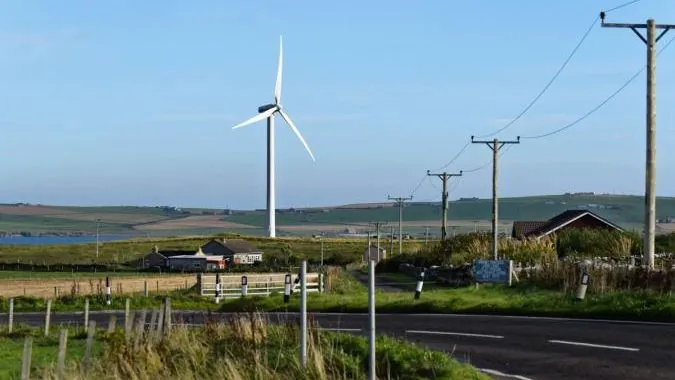
Bitcoin Policy Institute Proposes Mining to Absorb Scotland's Curtailed Wind Power
The Bitcoin Policy Institute proposes using Bitcoin mining to absorb surplus Scottish wind power that Britain currently pays farms to switch off. The report says the approach could reduce a grid bill that reached £393 million in 2024, though it flags banking and tax obstacles.
Written by CoinArticle’s AI Newsroom · from 2 cited sources. How we work
The Proposal
The Bitcoin Policy Institute (BPI) has argued in a new report that Britain could use Bitcoin mining to absorb surplus wind generation in Scotland, reducing payments to wind farms ordered to halt output. The institute frames miners as buyers of last resort for electricity that cannot reach demand centers.
The scale of the problem is set out in the report. Britain paid wind farms £393 million in 2024 to curtail 8.3 TWh of output, and the report attributes 98% of that curtailed output to Scotland. Sources differ on the broader cost picture: CoinDesk describes the bill as $1.3 billion, while Crypto Briefing's account of the same report cites the £393 million figure, so readers should treat the dollar framing as one outlet's conversion rather than a figure from the report itself.
Why Scotland Wastes the Power
The cause is largely physical. Scottish wind capacity has expanded faster than the transmission lines needed to move power south to England, where demand is highest. Grid operators therefore pay twice: they compensate Scottish wind farms for staying idle and compensate gas-fired plants further south for ramping up.
The report says the value of wind curtailment in Britain rose 91% year over year. That trend is the main reason BPI argues the waste is becoming a policy problem rather than a routine balancing cost.
Flexibility and Modeling
BPI's core argument rests on flexibility. Mining rigs can scale consumption up or down quickly, and they do not require delivery to a particular location. The report contrasts miners with firm loads such as AI data centers, which need steady power and are poorly matched to intermittent supply.
A separate modeling analysis from May 2026, cited in the coverage, estimated that a 20 MW mining operation paired with a 100 MW wind farm could consume 83% of that farm's curtailed energy. The same analysis projected a 32% lift in overall system revenue and a rise in the wind farm's effective capacity factor from 29% to 32%. These are modeled projections, not observed outcomes from a deployed site.
Obstacles and Context
The report identifies banking restrictions as the leading barrier, and cites inconsistent investment and tax rules as an additional drag on competitiveness. It also notes that Bitcoin has legal recognition as property in the UK, a point that sits uneasily beside the restrictions it describes.
Bitcoin Policy UK has published further papers and podcasts framing mining as demand-side flexibility that could support renewable targets. The mining-for-curtailment concept is not new globally, but the report argues Scotland's case is distinctive because nearly all of Britain's curtailment is concentrated in one region behind one set of transmission bottlenecks.
Why It Matters
For Traders
The proposal is a policy report rather than a enacted measure, so no near-term change to Bitcoin supply or miner economics is implied for the next few days.
For Investors
If grid operators begin treating flexible mining as a curtailment tool, the case for mining-linked renewable projects in Scotland could strengthen, but banking and tax barriers currently stand in the way.
For Builders
Developers of flexible mining or demand-response systems should watch how British regulators treat curtailment-linked loads, since the rules on grid connection and tax will determine project viability.
This article is for information only and is not financial advice. Read the full disclaimer.