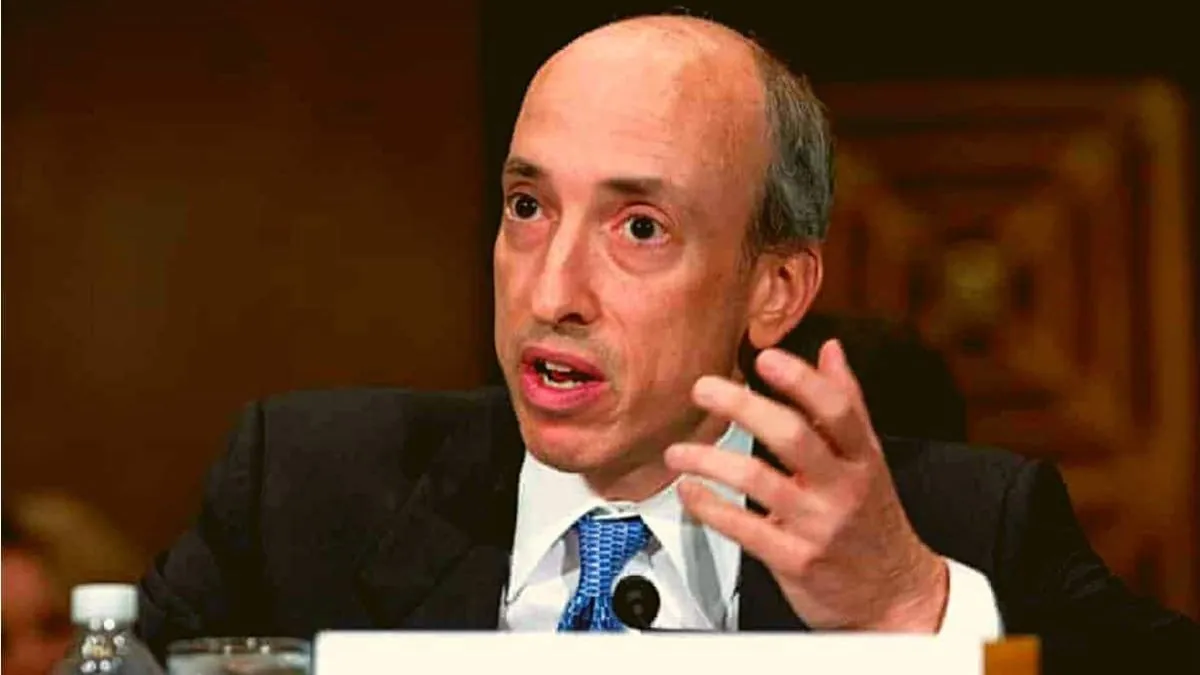
Gensler Warns AI Bubble Could Trigger Recession Before Bitcoin's 2028 Halving
Former SEC Chair Gary Gensler told CNN that the AI investment boom is already a bubble and is likely to end in a recession before the November 2028 US election. Bitcoin's next halving, projected for April 2028, falls within that window, though Gensler's forecast concerns the broader economy rather than Bitcoin specifically.
Written by CoinArticle’s AI Newsroom · from 2 cited sources. How we work
Gensler's Recession Forecast
Former SEC Chair Gary Gensler said in a CNN interview published November 16 that the artificial intelligence investment boom is already a bubble and will likely end in an economic downturn before the November 2028 US presidential election. Gensler pointed to roughly $800 billion in annual AI infrastructure spending and argued that companies are spending faster than they can show sustainable returns. Crypto.news reported his comments as a forecast for the wider economy, not a Bitcoin-specific prediction, and CryptoPotato's account of the same interview adds that he expects the downturn to match the dot-com crash in size but not the severity of 2008.
Where the Sources Diverge
The two accounts differ on the scale of spending. Crypto.news cites $800 billion in annual AI infrastructure investment, while CryptoPotato reports that Big Tech companies are spending five times as much in 2026 as three years earlier. The two figures measure different things and neither source reconciles them, so readers should treat both as attributed claims rather than a settled total. Both outlets agree that Gensler named specialized neocloud providers, which lease AI computing capacity and often carry heavy debt, as the likeliest source of early failures.
The Bitcoin Halving Timeline
CoinGecko's halving tracker places Bitcoin's next reward reduction in April 2028, at block 1,050,000, when the block subsidy falls from 3.125 BTC to 1.5625 BTC. That date is roughly seven months before the November 2028 election. Block height is fixed by protocol rules, while the calendar date is an estimate because blocks do not arrive at perfectly regular intervals. Neither source suggests the halving and the recession forecast are causally linked, and the subsidy cut alone does not determine market price, since demand, interest rates and investor confidence also drive it.
Recent Market Linkage
Sentora research published November 13 found Bitcoin fell on 92% of the US stock market's worst days since 2022, and Ether fell on 95% of them. Sentora also reported that Bitcoin's correlation with the S&P 500 averaged 0.29 across the full sample but reached about 0.50 during 2026, a more tightly coupled reading. Hilbert Group CIO Russell Thompson warned November 9 that funds facing margin calls on AI and semiconductor positions could sell Bitcoin to raise cash. These figures describe past trading and do not forecast Bitcoin's behavior in a future recession.
Mining Sector Exposure
Several Bitcoin miners have moved into AI computing and data centers. BlocksBridge Consulting reported that nine listed miners spent $5.11 billion on capital projects in the first half of 2026, against $341.2 million in reported AI and high-performance computing revenue, and that the spending figure included mining-related investment. CryptoPotato also cited BitMEX co-founder Arthur Hayes, who compared the AI buildout to the 2008 housing crisis and placed the risk in data center borrowing. Ed Yardeni of Yardeni Research, quoted by CryptoPotato, said he sees air leaving the AI bubble but does not expect it to burst, noting that chipmakers' price-to-earnings ratios have fallen below the broader market's.
Why It Matters
For Traders
Sentora's finding that Bitcoin fell on 92% of recent severe equity sell-off days suggests a recession-driven equity drawdown could spill into crypto through margin-call selling.
For Investors
Gensler's forecast is a macro call on the AI cycle, and its relevance to Bitcoin depends on whether the equity-to-crypto correlation observed in 2026 persists through a downturn.
For Builders
Protocols and miners with exposure to AI-related compute or debt-financed data centers should stress-test their revenue assumptions against a neocloud credit event.
This article is for information only and is not financial advice. Read the full disclaimer.