Zcash Developers Propose 20-Second Blocks Days After NU7 Upgrade
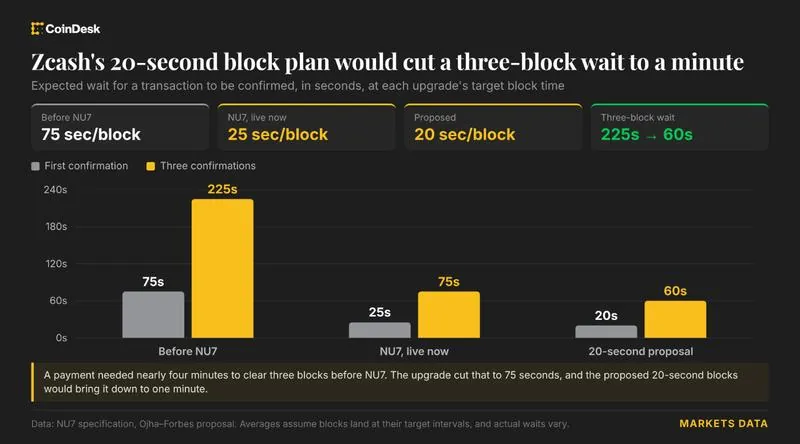
Zcash developers have proposed cutting block time from 25 seconds to 20 seconds, days after the NU7 upgrade reduced it from 75 seconds. Early orphan-rate data from ZecBlock shows the faster interval has not yet produced the spike in competing blocks developers had feared, though sources differ on the figures.
Written by CoinArticle’s AI Newsroom · from 2 cited sources. How we work
The Proposal
Zcash developers Dev Ojha, known as ValarDragon, and Evan Forbes published a proposal on the Zcash community forum on Nov. 8 to reduce block time from 25 seconds to 20 seconds. They want the change considered for the upcoming NU7.1 upgrade. The proposal has not received community approval, and no activation date has been confirmed.
Under the change, a transaction requiring one confirmation would have an expected wait of about 20 seconds, down from 25 seconds. For an exchange requiring three confirmations, the target would fall from 75 seconds to 60 seconds. Actual times will vary, because miners do not discover blocks at fixed intervals, and exchanges and other services can set their own confirmation requirements. The developers cited retail payments, exchange deposits and cross-chain swaps as the activities most likely to benefit.
Early Orphan-Rate Data
The central question for a shorter interval is whether more blocks will be orphaned, meaning miners produce competing blocks and only one is accepted. Sources agree that early results have been better than feared, but they report different figures. CoinDesk's headline framing describes the orphan-block rate as holding close to pre-upgrade levels. Crypto.news cites ZecBlock's mining tracker, which recorded an orphan rate of 0.69% over the 24 hours ending early Monday, against roughly 0.66% before NU7. Across the full period since the upgrade, ZecBlock's figure was 1.29%, reflecting an initial rise before readings declined.
The comparison is imperfect. ZecBlock expanded its monitoring from one node to ten shortly before the upgrade, so it can now detect competing blocks that previously went unrecorded. The earlier and current figures are therefore not directly comparable. Ojha said in a Monday update that the orphan rate had "gotten better than I anticipated."
Simulation Results and Trade-Offs
Separate testing used 80 miners across 12 geographic regions to model the 20-second interval under demanding conditions. Simulated orphan rates ranged from 1.9% to 3.3%, depending on mining software configuration. Earlier tests used to validate 25-second blocks recorded 4.68%, so the simulated figures sit below that benchmark, though they come from a different test design.
The technical plan also limits throughput. It would cut the maximum number of shielded actions per block from 330 to 264, and developers do not intend to raise the daily count of private transactions the network can process. The shorter interval is therefore a change to confirmation latency rather than capacity.
Context From NU7
NU7 activated on Nov. 6 at block 3,543,405, reducing the target block time from 75 seconds to 25 seconds without changing maximum supply. The same upgrade introduced new shielded transaction limits and a fee structure that reserves 60% of transaction fees for future mining rewards, with miners receiving the remaining 40% directly. The proposal for 20-second blocks is being weighed against this recent change, with the orphan-rate data from the first days of NU7 serving as the main evidence.
Why It Matters
For Traders
The proposal is unapproved with no activation date, so any effect on ZEC depends on a community vote and a future upgrade rather than near-term changes.
For Investors
Faster block production signals active protocol tuning after NU7, but the orphan-rate evidence is limited to days of data and monitoring changes muddy comparisons.
For Builders
Services relying on Zcash confirmation timing should plan for possible shorter wait intervals and re-test deposit logic if NU7.1 includes the change.
This article is for information only and is not financial advice. Read the full disclaimer.