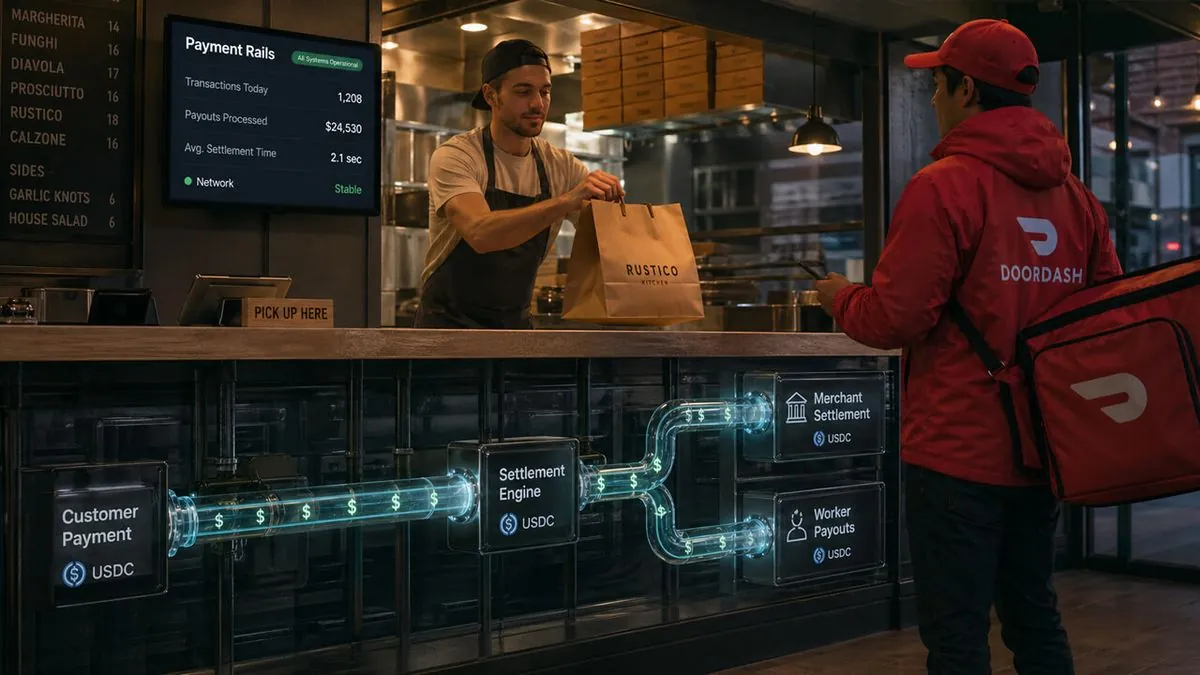
DoorDash Moves Merchant and Dasher Payouts Onto Stablecoin Rails Built on Tempo
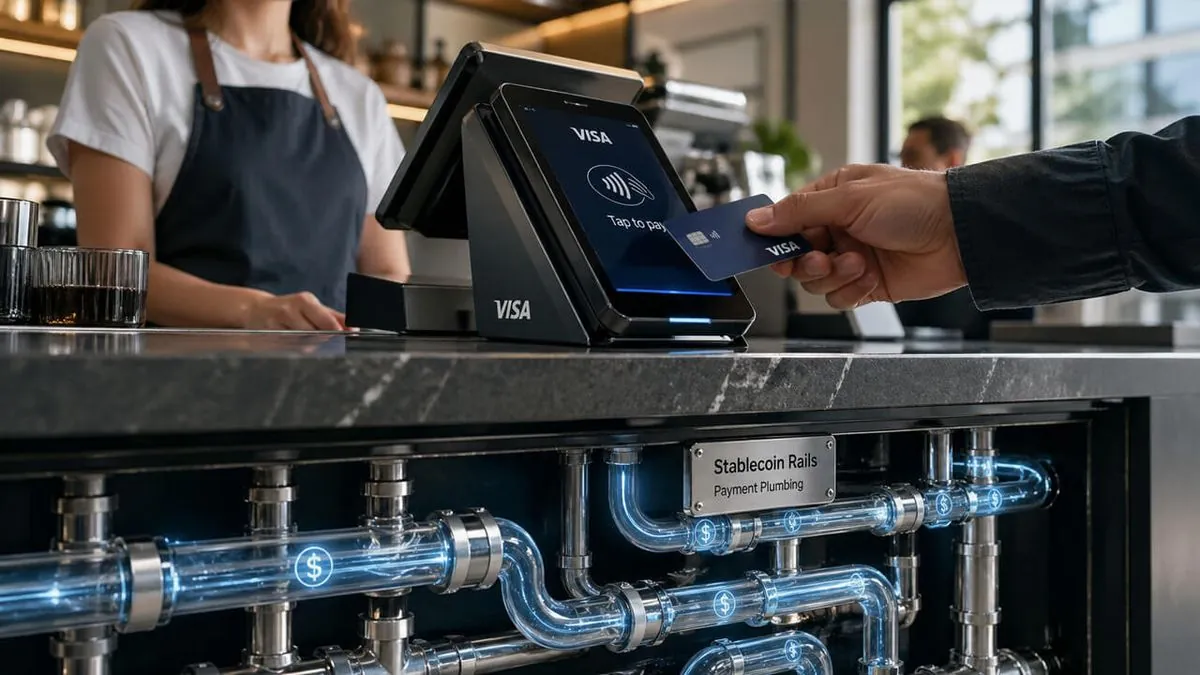
DoorDash is building stablecoin payment infrastructure on Tempo, the Stripe- and Paradigm-incubated Layer-1, to pay delivery workers and merchants across more than 40 countries. The company announced the project April 21, in what sources describe as one of the largest real-world stablecoin payment deployments by a publicly traded US company.
Written by CoinArticle’s AI Newsroom · from 2 cited sources. How we work
What DoorDash Announced
DoorDash said on April 21 that it is building stablecoin payment infrastructure on Tempo to pay its delivery workers, known as Dashers, and merchants in more than 40 countries. The company's head of payments said faster and cheaper payouts are the goal, and that the arrangement is designed to be invisible to end users, who will not need to interact with blockchain tooling directly.
DoorDash did not disclose a dollar value for the program or a timeline for full rollout. Coverage from crypto.news says the company will start with the payout flows where faster and cheaper settlement creates the most immediate value, prioritizing cross-border corridors. CryptoSlate reported that the company had confirmed the partnership through Tempo's own announcement.
Why Payout Infrastructure Is the Problem
DoorDash's three-sided marketplace links consumers, merchants and Dashers, each with different settlement timelines, currency exposures and compliance rules. Crypto.news notes that a payout flow that works in Atlanta may need an entirely different stack in Helsinki, Mexico City or Sao Paulo. Standard ACH-equivalent rails can take one to three business days to settle, which affects merchant payroll and inventory purchases and Dasher access to earnings.
CryptoSlate frames the issue as working capital and liquidity rather than novelty. The company had already addressed worker cash pressure earlier this year through gas relief measures for US Dashers and a parallel support program for Canadian Dashers. Stablecoin settlement is pitched as a way to compress those delays and fixed costs at scale.
Tempo's Role and Ecosystem Context
Tempo is a payments-focused Layer-1 with sub-second deterministic finality, fees paid in dollar-denominated stablecoins, reserved blockspace for payment workloads and ISO 20022 support for enterprise reconciliation. Tempo raised $500 million at a $5 billion valuation before its March 2026 mainnet launch, with Stripe and Paradigm as founding investors and Paradigm co-founder Matt Huang as CEO. DoorDash said it chose Tempo for its payments focus and enterprise readiness.
The DoorDash announcement came alongside confirmations from Tempo that Stripe, Coastal Community Bank, Fifth Third Bank and Latin American fintech ARQ are running or preparing payment operations on the network. Crypto.news reported that Klarna plans a stablecoin on Tempo's mainnet, and that Visa, Nubank and Shopify were cited as early ecosystem participants during testnet. Stripe processed $1.9 trillion in payment volume in 2025, per crypto.news.
Points of Divergence in Coverage
The two source reports differ on the scale of DoorDash's footprint. Crypto.news cites nearly $75 billion in merchant sales last year, a figure the CryptoSlate piece does not repeat. Both outlets describe the deployment as operational rather than speculative, but CryptoSlate places more weight on the broader industry signal, arguing the move shows stablecoins entering operating infrastructure instead of only trading or treasury use. Crypto.news frames it as a single-company case study of enterprise fit. Neither source reports settlement-time benchmarks from live DoorDash payouts, so the speed and cost improvements remain company claims rather than measured results.
Why It Matters
For Traders
Watch for DoorDash or Tempo to disclose payout volumes or live settlement data, since the announcement itself gives no measurable figures to price against.
For Investors
A large publicly traded consumer platform committing payout flows to stablecoin rails is a structural signal that stablecoins are gaining a role in operating payments, not only trading.
For Builders
Tempo's stablecoin-denominated fees and reserved payment blockspace show the design targets enterprise payout workloads, which changes how payment-facing dApps should model cost and finality.
This article is for information only and is not financial advice. Read the full disclaimer.